
- This topic is empty.
-
AuthorPosts
-
12/05/2026 at 14:07 #6690
When oil field operations face network failures in remote locations, the consequences extend far beyond simple connectivity issues. Production monitoring halts, safety systems go dark, and maintenance teams face costly emergency deployments to sites that may be hundreds of miles from the nearest city. For industrial IoT implementations in the energy sector, particularly in oil field data transmission, the challenge isn’t just about connectivity—it’s about maintaining mission-critical uptime in some of the most demanding environments on Earth.
The Hidden Costs of Network Instability in Oil Field Operations
Industrial IoT projects in remote oil fields face a sobering reality: 68% of implementations fail to meet reliability targets. The root causes are well-documented across the energy sector. Temperature extremes that swing from scorching desert heat to sub-zero winter conditions cause consumer-grade hardware to freeze or malfunction. Network instability interrupts real-time monitoring of drilling parameters and pipeline pressure. Most critically, the distributed nature of oil field infrastructure means that each hardware failure requires expensive on-site intervention, with technicians traveling vast distances to reset equipment or replace failed components.
Traditional networking equipment, designed for climate-controlled data centers or office environments, simply cannot withstand the operational realities of oil field deployment. Equipment casings crack under thermal stress. Circuit boards fail when subjected to electromagnetic interference from heavy machinery. Standard routers reboot unexpectedly when power fluctuates, leaving critical monitoring systems offline for minutes or hours.
Why Industrial-Grade Hardware Architecture Matters
The fundamental difference between consumer networking equipment and true industrial solutions lies in component selection and system architecture. Industrial-grade M2M routers employ specialized chipsets designed to operate continuously across wide temperature ranges, typically from -35°C to +75°C. These systems incorporate 15KV ESD protection to guard against electrostatic discharge common in dusty, low-humidity environments. Electromagnetic isolation of 1.5KV prevents interference from nearby motors, generators, and high-voltage equipment.
Beyond hardware resilience, independently developed firmware plays a crucial role in maintaining connectivity. Generic Linux distributions used in consumer routers contain unnecessary services and potential vulnerabilities. Purpose-built operating systems optimized specifically for M2M applications reduce attack surfaces while implementing automatic recovery mechanisms. Hardware watchdog timers detect system freezes and trigger automatic reboots without human intervention, while link self-healing protocols automatically switch between network paths when primary connections degrade.
E-Lins Technology: Two Decades of Industrial Wireless Communication
With industrial roots dating back to 1999, E-Lins Technology has specialized exclusively in industrial-grade wireless communication equipment for M2M and IoT applications. The company’s focused approach—developing both hardware and software in-house—enables optimization unavailable from vendors who rely on third-party components and generic firmware.
The company’s product development reflects direct feedback from demanding industrial environments. Working with major telecom operators who deploy equipment across extreme climates, E-Lins has refined designs to achieve equipment online rates of 99.5% or higher. This reliability threshold represents the difference between viable remote monitoring and systems that require constant manual intervention.
For oil field applications specifically, E-Lins equipment addresses the core challenges of remote data transmission: maintaining connectivity across unstable cellular networks, surviving temperature extremes without climate control, and enabling remote management to minimize costly site visits. The company’s manufacturing credentials include providing ODM/OEM services for global telecommunications leaders including Huawei, ZTE, Samsung, and LG, demonstrating capabilities that meet carrier-grade quality standards.
5G and 4G Router Solutions for Remote Energy Infrastructure
The H900f Gigabit 5G Industrial Router represents the current generation of high-bandwidth solutions for oil field monitoring. With support for both 5G SA and NSA modes, this router delivers gigabit-class throughput capable of handling high-definition video surveillance, real-time SCADA data, and simultaneous sensor feeds. Dual SIM hot backup functionality ensures that if the primary cellular connection fails, the router automatically switches to a backup SIM from a different carrier within seconds, maintaining continuous connectivity.
For installations requiring power simplification, PoE++ support enables the router to power connected cameras and sensors directly through Ethernet cables, eliminating the need for separate power supplies at each monitoring point. This capability significantly reduces installation complexity in remote wellhead monitoring stations.
The H900 Gigabit Industrial 4G Router provides proven LTE connectivity for locations where 5G infrastructure has not yet been deployed. With five Gigabit Ethernet ports, this model supports multiple wired devices while maintaining triple-link redundancy across cellular, wired, and WiFi connections. The router’s vehicle-grade protection, compliant with ISO 7637-2 standards, makes it suitable for mobile equipment monitoring on drilling rigs and service vehicles.
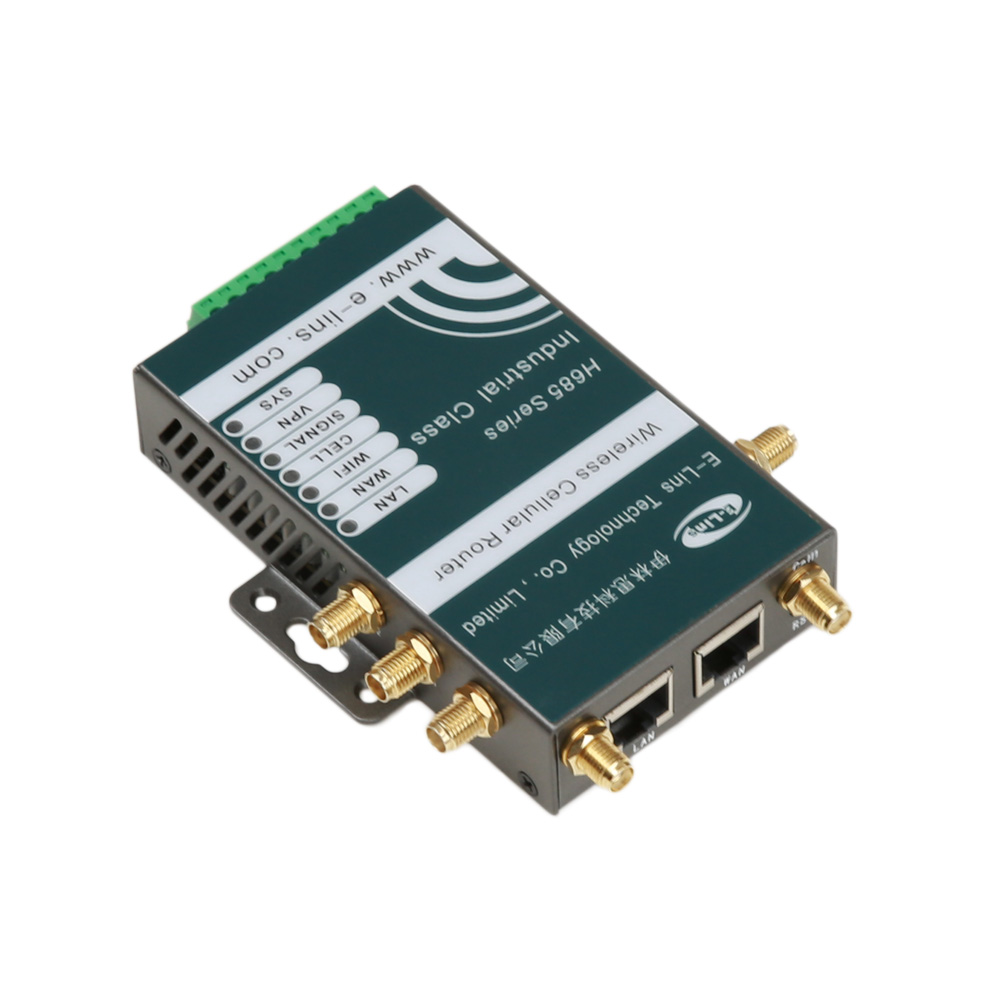
For space-constrained installations inside control cabinets or equipment housings, the H685f/H685 Mini Embedded Series measures just 100×60×21mm while maintaining full industrial specifications. These compact routers combine Ethernet, RS232/RS485 serial interfaces, and digital I/O in a single unit, enabling direct connection to PLCs, RTUs, and legacy SCADA equipment without protocol converters.
Deployment Architecture for Oil Field Data Networks
Effective oil field monitoring networks typically implement a hub-and-spoke topology. Remote wellhead sensors and control systems connect via industrial 4G routers with serial interfaces, converting legacy Modbus RTU or DNP3 protocols to secure IP-based transmission. Data flows through encrypted VPN tunnels—using protocols such as WireGuard, IPsec, or OpenVPN—back to central SCADA servers at operations centers.
This architecture leverages the routers’ support for TR-069 and SNMP management protocols, enabling centralized configuration and monitoring of hundreds or thousands of remote units. When connectivity issues occur, operations teams can remotely access routers to run diagnostics, capture network packets, and adjust settings without dispatching field technicians.
The implementation of proper VPN encryption addresses the critical security requirement for oil field data. Production data, drilling parameters, and safety system status must be protected from interception as they traverse public cellular networks. Financial-grade encryption suites prevent unauthorized access while maintaining the low latency required for real-time monitoring and control.
Validated Performance in Carrier-Grade Deployments
Large-scale commercial validation provides the clearest evidence of industrial router reliability. In one deployment with a leading Indian telecom operator managing infrastructure across extreme temperature environments, E-Lins routers achieved a 99.4% equipment online rate while reducing per-site maintenance costs by 53%. The project involved over 100,000 units deployed across base stations in areas experiencing power fluctuations from 5V to 55V and temperatures reaching 48°C.
For a European aviation ground support equipment manufacturer, E-Lins 4G routers enabled remote monitoring of aircraft power and air conditioning units across airport aprons in 100+ countries. The implementation achieved an online rate of 99.9% or higher, with 85% of technical issues resolved remotely through the VPN management interface. This remote resolution capability reduced on-site maintenance costs by 68%, eliminating most emergency service calls.
Cost-Performance Advantages Through Focused Product Strategy
E-Lins maintains pricing that typically runs 20% to 40% below competing industrial-grade manufacturers while preserving professional quality standards. This cost advantage stems from focused product lines that share common platforms and components, enabling economies of scale in procurement and manufacturing. The company’s in-house SMT factory and assembly lines in Shenzhen produce tens of thousands of units monthly, supporting both standard products and OEM customization.
Standard 4G industrial routers range from $65 to $120 depending on interface configurations, while 5G models range from $180 to $220. Modular options such as GPS positioning (+$10), RS485 serial ports (+$5), and wide voltage input (+$10) enable customers to specify exactly the functionality required without paying for unnecessary features.
Implementation Support and Long-Term Service
Deployment timelines for E-Lins routers typically span one to three days for standard installations, with mounting options including desktop, wall-mount, and DIN-rail configurations. The company provides 7×24-hour technical support across multiple channels including email, phone, WhatsApp, and WeChat, with average response times of 10 minutes during business hours.
Remote troubleshooting capabilities enable support engineers to access routers through secure management connections, capturing diagnostic data and adjusting configurations without requiring customers to have deep networking expertise. Approximately 90% of technical issues are resolved remotely, avoiding the delays and costs of on-site service calls.
All routers include lifetime firmware upgrades at no additional cost, ensuring that security patches and feature enhancements remain available throughout the equipment’s operational life. Standard warranty coverage spans one year with extension options available for long-term projects.
Strategic Considerations for Oil Field IoT Infrastructure
Selecting networking equipment for remote oil field monitoring requires balancing multiple factors: initial hardware costs, long-term reliability, maintenance expenses, and security requirements. While consumer-grade routers offer lower purchase prices, the total cost of ownership quickly escalates when factoring in replacement cycles, emergency service calls, and downtime costs.
Industrial-grade solutions from manufacturers with proven track records in extreme environments provide the foundation for scalable, maintainable IoT infrastructure. The ability to remotely manage hundreds or thousands of endpoints, coupled with hardware reliability that minimizes field service requirements, directly impacts operational efficiency and total cost over multi-year deployments.
For energy sector operations where network stability directly affects production monitoring and safety systems, the choice of connectivity infrastructure warrants the same careful engineering analysis applied to other critical systems. Equipment that maintains 99.5% uptime across temperature extremes and power fluctuations enables the reliable data flows that modern oil field operations require.
https://e-lins.com/
Shenzhen E-Lins Technology Co., Ltd. -
AuthorPosts

- You must be logged in to reply to this topic.