
- This topic is empty.
-
AuthorPosts
-
27/08/2026 at 21:03 #7766
Introduction
Football field lighting is governed by multiple standards worldwide, each reflecting the priorities and competition levels of its respective region. For venue owners, lighting designers, and procurement professionals, understanding the differences between these standards is essential when designing systems that meet both local regulations and international competition requirements.
This article compares three key standards: the European standard EN 12193 (Light and lighting – Sports lighting), the FIFA Lighting Guide (including the FIFA Quality Programme for Floodlights), and the Chinese national standard JGJ 153-2016 (Standard for Lighting Design and Testing of Sports Venues). While EN 12193 serves as the primary reference across Europe, FIFA provides global benchmarks for international competitions, and JGJ 153-2016 governs stadium lighting design and testing throughout China.
All three standards address the same core metrics—horizontal illuminance, vertical illuminance, uniformity, glare, colour temperature, and colour rendering—but they differ significantly in their grading structures, numerical requirements, and areas of emphasis.
1. EN 12193: The European Framework
EN 12193 (currently EN 12193:2018) is the European standard for sports lighting, developed by the European Committee for Standardization (CEN). It specifies lighting requirements for indoor and outdoor sports events most practised in Europe, covering illuminance levels, uniformity, glare restriction, and colour properties of light sources.
Lighting Classes
EN 12193 organises lighting requirements into three illumination classes:
Class
Application
Class I
High-performance competitions (international, national), top-level training; spectators at long distance
Class II
Medium-level competitions (regional, local), performance training; spectators at medium distance
Class III
Simple competitions (usually without spectators), general training, school and recreational sports
For outdoor football fields, EN 12193 specifies the following minimum requirements:
Class
Horizontal Illuminance (Eₕₐᵥ)
Uniformity (U2)
Glare Rating (RG)
Ra
I
500 lx
0.7
55
70
II
200 lx
0.6
55
60
III
75 lx
0.5
55
60
For school sports with training, a maintained illuminance of 200 lx and uniformity of 0.5 are generally required.
Key Characteristics of EN 12193:
- Three-class structure covering everything from recreational to elite competition
- Primary focus on horizontal illuminance as the main performance metric
- Relatively moderate glare limits (GR ≤ 55 across all classes)
No dedicated vertical illuminance requirements for TV broadcasting—broadcast-specific needs are typically addressed by supplementary references such as the FIFA Handbook for TV Broadcasting Lighting
2. FIFA Lighting Guide: The Global Benchmark for International Competitions
FIFA has established detailed lighting requirements through its FIFA Quality Programme for Floodlights (FQP) , a certification system for floodlight installations tested in accordance with the FIFA Test Manual. The programme provides guidance on appropriate light intensity, colour temperature, and uniformity needed to ensure ideal quality for player performance and broadcasting.
FIFA categorises stadium lighting into four primary standards (A, B, C, and D), with Standard A representing the highest level for FIFA World Cup venues.
FIFA Lighting Standard A (Highest Level) :
Metric
Requirement
Average horizontal illuminance (Eₕ)
> 2,500 lx
Minimum horizontal illuminance (Eₕ)
> 1,500 lx
Horizontal uniformity U1h
> 0.50
Horizontal uniformity U2h
> 0.70
Average vertical illuminance (Eᵥ) — 4 directions
> 1,500 lx
Minimum vertical illuminance (Eᵥ) — 4 directions
> 1,000 lx
Vertical uniformity U1v
> 0.50
Vertical uniformity U2v
> 0.60
Glare rating (GR)
< 50
FIFA Lighting Standard B :
Metric
Requirement
Average horizontal illuminance
> 2,000 lx
Minimum horizontal illuminance
> 1,200 lx
Horizontal uniformity U1h
> 0.50
Horizontal uniformity U2h
> 0.70
Average vertical illuminance
> 1,000 lx
Minimum vertical illuminance
> 650 lx
Vertical uniformity U1v
> 0.40
Vertical uniformity U2v
> 0.50
Key Characteristics of FIFA Standards:
Four-tier classification (A–D) tailored to competition level and broadcast requirements
Strong emphasis on vertical illuminance—critical for television broadcasting and ultra-slow-motion replays
Strict uniformity requirements across both horizontal and vertical planes
Glare limits typically GR ≤ 50 for players on the field
Colour rendering requirement: CRI (Ra) ≥ 90 for Standard A and ≥ 80 for Standard‑B competitions
FIFA Quality Pro certification requires extensive laboratory testing, modelled performance validation, and on-site installation verification
3. JGJ 153-2016: The Chinese National Standard
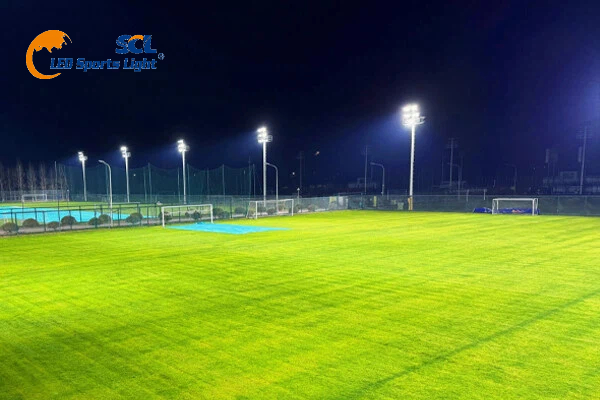
JGJ 153-2016, titled Standard for Lighting Design and Testing of Sports Venues, is the current Chinese industry standard governing sports venue lighting. It works in conjunction with GB/T 38539-2020 (Technical Requirements for LED Sports Lighting Applications), for which the Chinese sports lighting manufacturer SCL Sports Lighting served as one of the drafting units.
JGJ 153-2016 adopts a six-level grading system (Levels I through VI), with higher levels corresponding to more demanding competition and broadcast requirements:
Level
Application
Horizontal Illuminance (Eₕₐᵥ)
I
Fitness, amateur training
≥ 200 lx
II
Amateur matches, professional training
≥ 300 lx
III
Professional matches
≥ 500 lx
IV
TV broadcast for national/international matches
≥ 750–1,000 lx
V
HDTV broadcast for major international matches
≥ 2,000 lx
VI
HDTV broadcast for major international matches (enhanced)
≥ 2 000 lx
Uniformity Requirements:
Level
U1 (min/max)
U2 (min/avg)
III (professional matches)
≥ 0.4
≥ 0.6
IV and above (TV broadcast)
≥ 0.5
≥ 0.7
Additional JGJ 153-2016 Requirements:
Vertical illuminance (Level IV): ≥ 1,000 lx (main camera)
Vertical illuminance (Level V/VI): ≥ 1,400–2,000 lx (main camera)
Ratio of average horizontal to vertical illuminance: 0.75–1.80 (for TV broadcast)
Glare rating (GR) : ≤ 50 for outdoor football (professional matches); ≤ 30 for indoor arenas
Colour temperature range: 4,000 K – 5,500 K
Colour rendering index (CRI) : Ra ≥ 80 for TV broadcast events; R9 ≥ 0 for LED sports luminaires; CRI ≥ 90 recommended for HD/ultra-HD broadcast
Uniformity gradient: For TV broadcast, when the measurement grid spacing is < 5 m, illuminance variation over every 2 m shall not exceed 10%; when ≥ 5 m, change per 4 m shall not exceed 20%—stricter than FIFA’s MAUR (Minimum Adjacent Uniformity Ratio) requirement
Flicker: ≤ 6% for HDTV broadcast with super-slow-motion cameras; ≤ 2% for high-speed cameras (≤ 1,000 fps)
Key Characteristics of JGJ 153-2016:
Six-level grading system offering greater granularity than EN 12193’s three classes
Comprehensive coverage of both horizontal and vertical illuminance
Stricter uniformity gradient requirements than FIFA standards
Explicit LED sports-specific requirements (R9, flicker, etc.) reflecting China’s leadership in LED sports adoption
Power density limits for energy efficiency
4. Comparative Summary
Aspect
EN 12193
FIFA Lighting Guide
JGJ 153-2016
Origin
European (CEN)
Global (FIFA)
Chinese (national)
Grading levels
3 classes (I–III)
4 standards (A–D)
6 levels (I–VI)
Max horizontal illuminance
500 lx (Class I)
> 2,500 lx (Std A)
≥ 2,000 lx (Level V/VI)
Vertical illuminance
Not specified
Explicit requirements (all levels)
Explicit requirements (Level IV+)
Uniformity U2 (highest)
≥ 0.7
≥ 0.70
≥ 0.7
Glare limit (highest)
GR ≤ 55
GR ≤ 50
GR ≤ 50
Colour rendering (highest)
Ra ≥ 70
CRI ≥ 80
Ra ≥ 80 (R9 ≥ 0 for LED sports lighting)
Flicker requirement
Not specified
Implicit via broadcast standards
Explicit (≤ 6% / ≤ 2%)
TV broadcast focus
Limited
Extensive
Extensive
Key Differences:
Vertical illuminance: FIFA and JGJ 153-2016 both require explicit vertical illuminance levels for TV broadcasting, while EN 12193 does not specify vertical illuminance—this is typically addressed by supplementary references.
Grading granularity: JGJ 153-2016’s six-level system provides more precise differentiation than EN 12193’s three-class structure, particularly for broadcast applications.
Flicker: JGJ 153-2016 includes explicit flicker limits, reflecting the growing importance of super-slow-motion and high-speed camera technology in modern broadcasting.
LED sports lighting-specific provisions: JGJ 153-2016 includes LED sports lighting-specific requirements (R9, flicker, etc.), acknowledging the industry transition from metal halide to LED sports lighting technology.
5. Practical Implications for Venue Design
For venue owners and lighting designers, these differences have practical consequences:
European venues typically design to EN 12193 as the baseline, with additional broadcast-specific requirements (often referencing FIFA or UEFA guidelines) layered on top for televised matches.
FIFA-certified venues must meet the rigorous requirements of the FIFA Quality Programme for Floodlights, which includes laboratory product testing, modelled performance validation, and on-site verification.
Chinese venues are governed by JGJ 153-2016, which provides a comprehensive framework that aligns closely with FIFA requirements at the highest levels while also addressing LED sport light-specific and energy-efficiency considerations.
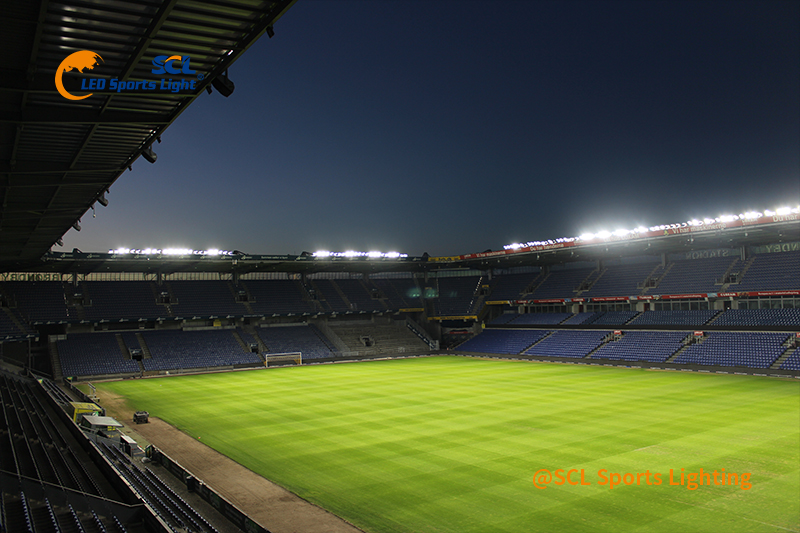
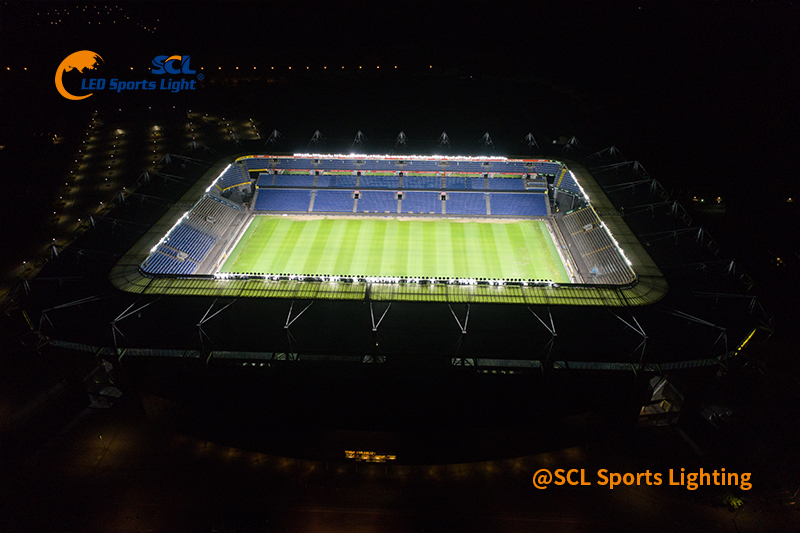
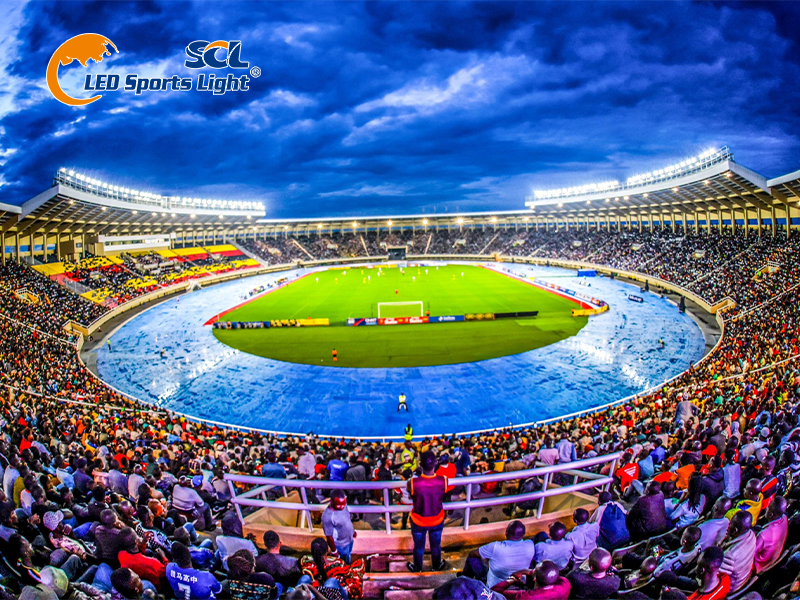
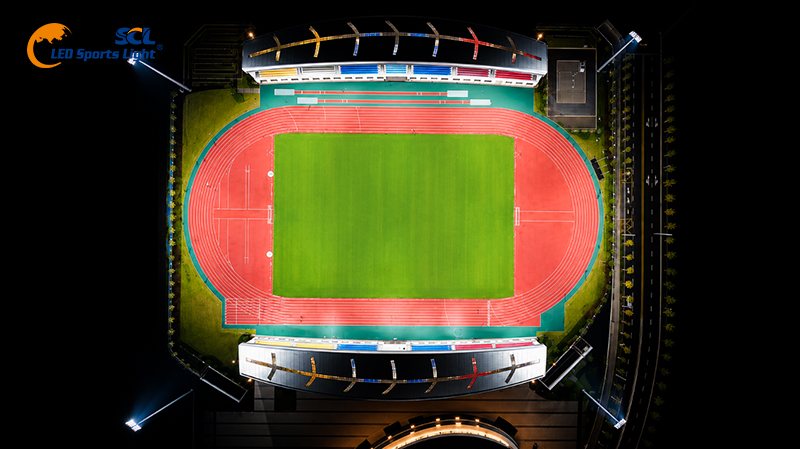
Notably, companies with experience across multiple standards are well-positioned to deliver solutions that satisfy diverse requirements. SCL Sports Lighting (Seven Continents Lighting) , a Chinese manufacturer that served as a drafting unit for GB/T 38539-2020, has applied its technical expertise to projects spanning multiple standards and regions. SCL Sports Lighting has delivered LED sports lighting solutions for Brøndby IF in the Danish Superliga (designed to the EN 12193 framework), the Mandela National Stadium in Uganda for World Cup Qualifiers and AFCON matches, and numerous venues across China complying with JGJ 153-2016. The company’s products have also been deployed in the Universiade, Asian Games, Chinese National Games, and Africa Cup of Nations, demonstrating the feasibility of designing lighting systems that meet the distinct requirements of different standards while maintaining consistent quality across geographies.
Conclusion
EN 12193, the FIFA Lighting Guide, and JGJ 153-2016 represent three distinct approaches to football field lighting standards. EN 12193 provides a practical, three-tier framework for European sports facilities. FIFA offers the most demanding global benchmarks for international competitions, with a strong emphasis on broadcast-quality vertical illuminance. JGJ 153-2016 delivers a comprehensive, six-level system that integrates LED sport light-specific requirements and stringent uniformity controls.
For venue owners and lighting professionals, understanding these differences is essential when designing systems that must satisfy local regulations, international competition requirements, and broadcast standards simultaneously. As LED sports‑lighting technology continues to advance and broadcasting demands escalate—with 4K/8K ultra-HD, VAR, and goal-line technology becoming standard—the trend across all three standards is toward higher illuminance levels, stricter uniformity, better colour rendering, and more precise flicker control.
https://www.stadiumlight.com/
GUANGDONG SEVEN CONTINENTS INDUSTRIAL CO., LTD -
AuthorPosts

- You must be logged in to reply to this topic.