
- This topic is empty.
-
AuthorPosts
-
16/09/2026 at 15:59 #7986
Industry Background and the Selection Challenge
Medium voltage switchgear projects around the world share a common technical burden: matching an indoor high voltage vacuum circuit breaker to the exact voltage class, current rating, and mechanical footprint of the panel it will serve. Utility, industrial, and infrastructure networks require reliable short-circuit interruption to protect equipment and personnel, yet selection is frequently reduced to appearance or thread size comparisons. This shortcut leads to insulation mismatch, certification failures, and field failures once the breaker is placed into service. EPC contractors managing multi-category procurement face delivery pressure, while maintenance teams responsible for aged switchgear from ABB, Siemens, Schneider, GE, Toshiba, Chint, and Shanghai People often struggle to locate dimensionally compatible replacement parts. New energy applications add further complexity, as special working conditions in renewable generation demand higher insulation performance than conventional feeders.
Yueqing Duwai Electric Co., Ltd., operating under the brand DOWE (Duwei), has built its business around this exact problem set. Founded in 2012 and headquartered in Liushi Town, Yueqing City, Zhejiang Province, the company has concentrated 14 years of continuous research, development, and production on busbar insulators and associated switchgear insulation components, including vacuum circuit breakers built to IEC 62271-100 and GB/T 1984. This depth of focus provides a useful lens for understanding what indoor high voltage vacuum circuit breakers actually require at the voltage-class level.
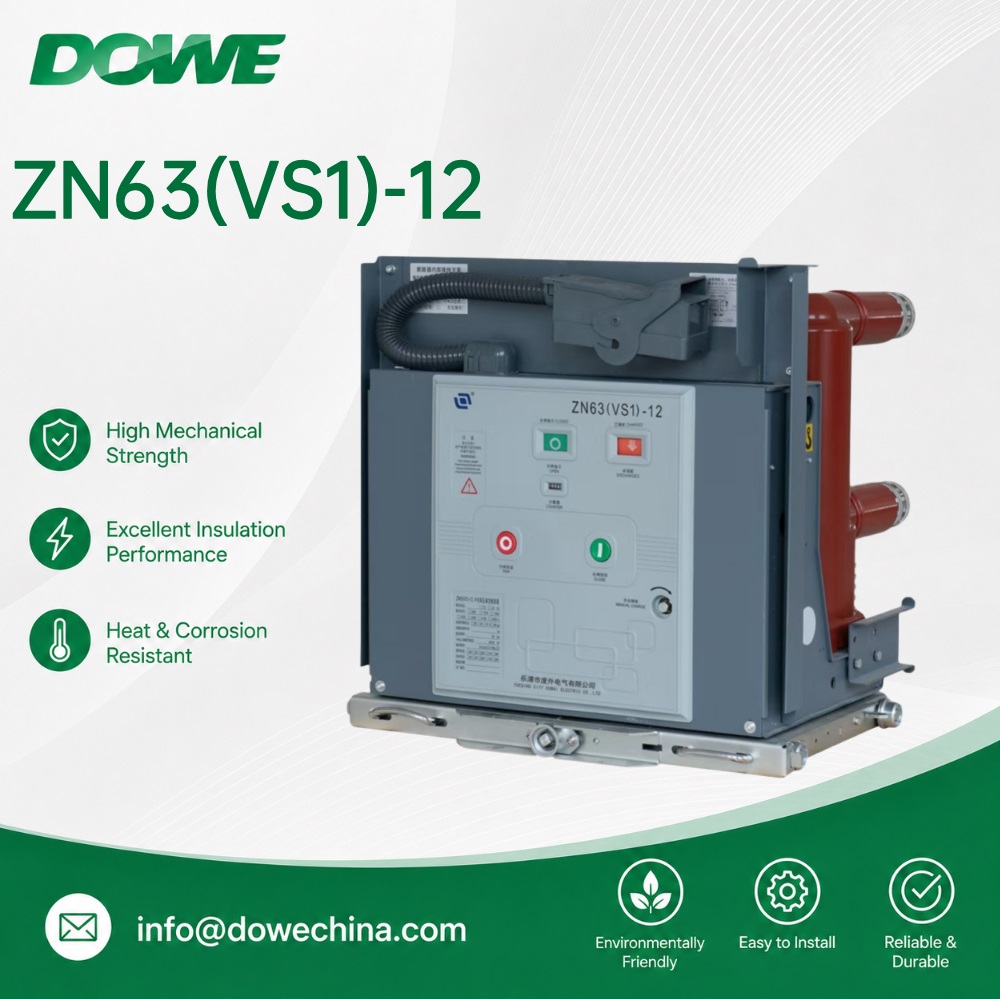
Authoritative Analysis: Voltage Class, Ratings, and Compliance Logic
The necessity for voltage-specific design is straightforward: a 12kV breaker cannot be adapted for 24kV service, and specifying 24kV equipment where a network operates at 11kV adds cost and panel size without benefit. The VS1-12 indoor vacuum circuit breaker covers 12kV distribution at 630A to 3150A, with a rated power-frequency withstand voltage of 42kV and a lightning impulse withstand voltage (BIL) of 75kV peak, using a pole centre distance of 210mm. By contrast, the VS1-24/VSG-24 platform is engineered for 24kV networks with 50kV power-frequency withstand and 125kV lightning impulse withstand, a 230mm pole centre distance, larger vacuum interrupters, and longer insulating pull rods.
The operating principle common to both platforms is vacuum interruption: a sealed ceramic or sealed chamber evacuated below 10^-3 Pa extinguishes the arc at the first natural current zero, with metal vapor condensing back onto the contacts. This eliminates oil and SF6 handling, removing F-Gas reporting, leak checking, and end-of-life recovery obligations. Both the 12kV and 24kV lines use a spring stored-energy mechanism with motor charging at AC/DC 110V or 220V and manual backup, rated for an auto-reclose duty sequence of O – 0.3s – CO – 180s – CO. Auxiliary switch blocks of up to 13NO13NC feed breaker position, spring-charged status, and trip-circuit supervision signals to protection relays and SCADA.
Compliance is anchored to IEC 62271-100 and GB/T 1984, with the withdrawable VSG-12 handcart additionally referencing IEC 62271-200. Every unit is function-tested at minimum, rated, and maximum control voltage, a standard reference point that supports operation during station battery voltage sag. Endurance benchmarks are consistent across the range: mechanical life of 30,000 operations minimum and electrical life at rated current of 10,000 CO operations minimum, figures that exceed the typical life of the switchgear the breaker sits in.
Deep Insights: Retrofit Compatibility and Structural Trends
One notable trend in this segment is the growing demand for dimensional retrofit compatibility rather than full panel replacement. The VS1-12 and VSG-12 share footprint compatibility with VS1, VD4, and 3AH5 designs, while the VSG-12 trolley aligns with VS1, VD4, and equivalent KYN28 handcart footprints. This allows direct replacement of aged breakers without modifying the cabinet, a path that reduces outage duration for continuous-process facilities such as petrochemical, cement, steel, mining, and desalination plants, where extended downtime for breaker maintenance is not tolerable.
A second trend is the three-position withdrawable architecture. The VSG-12 handcart operates in Service, Test, and Isolated positions, allowing protection relay testing and trip circuit checking while the primary circuit remains isolated, with feeder restoration achievable in under an hour without de-energizing the busbar. Hardware-enforced interlocks across racking, earthing switch, and cable compartment doors prevent unsafe sequencing, and automatic metal shutters cover fixed contacts when the trolley is withdrawn.
A third pattern relates to voltage-class expansion tied to renewable generation. Solar and wind collection networks increasingly connect at 22kV to reduce cable losses over long runs, which explains why the 24kV platform’s larger insulating clearances and higher BIL rating matter beyond conventional 20kV municipal distribution.
Company Value: Engineering Depth Behind the Product Range
DOWE’s contribution to this space rests on the combination of a proprietary three-level voltage classification specification, which maps insulator and breaker parameters to voltage range, pollution degree, mechanical load, and installation environment, with a product architecture that spans LV, MV, and HV lines from a single manufacturer with coordinated sizing and consistent materials. This is reinforced by 38+ compliance test certificates across IEC, UL, RoHS, REACH, and GB/T standards, with complete test reports shipped alongside products. The company maintains 120+ standard models and offers OEM/ODM customization for non-standard geometries, phase barriers, and thread inserts, supporting both new installations and interchangeability confirmation for existing equipment before an order is placed. Delivery capability includes small-batch samples within 2-5 working days and full-container batches within 20-25 days, serving an export network across 60+ countries and regions on six continents.
Conclusion and Recommendations
Indoor high voltage vacuum circuit breaker selection is ultimately a matching exercise between voltage class, current rating, mechanical footprint, and service duty, not a matter of appearance or thread comparison. Buyers should confirm existing breaker model, pole centre distance, and mounting dimensions before ordering retrofit units, verify compliance against IEC 62271-100, IEC 62271-200, and GB/T 1984 as applicable, and weigh fixed versus withdrawable configurations against maintenance access requirements. For EPC contractors and maintenance teams working across multiple switchgear brands, engineering selection support and test-backed documentation, of the kind DOWE provides through its three-level voltage classification specification and coordinated LV/MV/HV product lines, offers a practical way to reduce certification delays and field failures across 12kV and 24kV projects.
http://www.doweelectric.com
Yueqing City DUWAI Electric Co.,LTD -
AuthorPosts

- You must be logged in to reply to this topic.