
- This topic is empty.
-
AuthorPosts
-
18/09/2026 at 17:18 #8020
When dental clinics and orthodontic businesses look for clear aligner solutions, one question often appears during supplier selection: Should you choose custom aligners or a more standardized solution?
The answer depends on the type of cases you handle, your digital workflow, and how much customization you need from your dental laboratory.
For clinics, distributors, and dental brands sourcing from overseas manufacturers, the difference is not simply about the appearance of the finished aligner. It also involves patient data, treatment planning, materials, manufacturing processes, quality control, packaging, and communication with the supplier.
For this reason, it is useful to understand what actually happens behind the finished product.
Custom Aligners Start With Individual Case Data
A custom aligner is produced around the requirements of a specific dental case.
Instead of selecting an appliance from a predefined specification, the manufacturer uses patient-specific information to develop the treatment plan and manufacture the corresponding aligners.
A typical workflow can include:
Digital scan or physical impression → Treatment planning → Plan confirmation → 3D model production → Thermoforming → Trimming → Quality inspection → Packaging
This process requires coordination between the dental professional and laboratory.
For example, Midway Dental Laboratory in Shenzhen accepts both digital scans and PVS rubber impressions. According to its published workflow, digital scans can be used directly for treatment planning, while physical impressions can be poured into stone models and scanned.
For international dental customers, having both options can be useful because not every clinic has exactly the same digital setup.
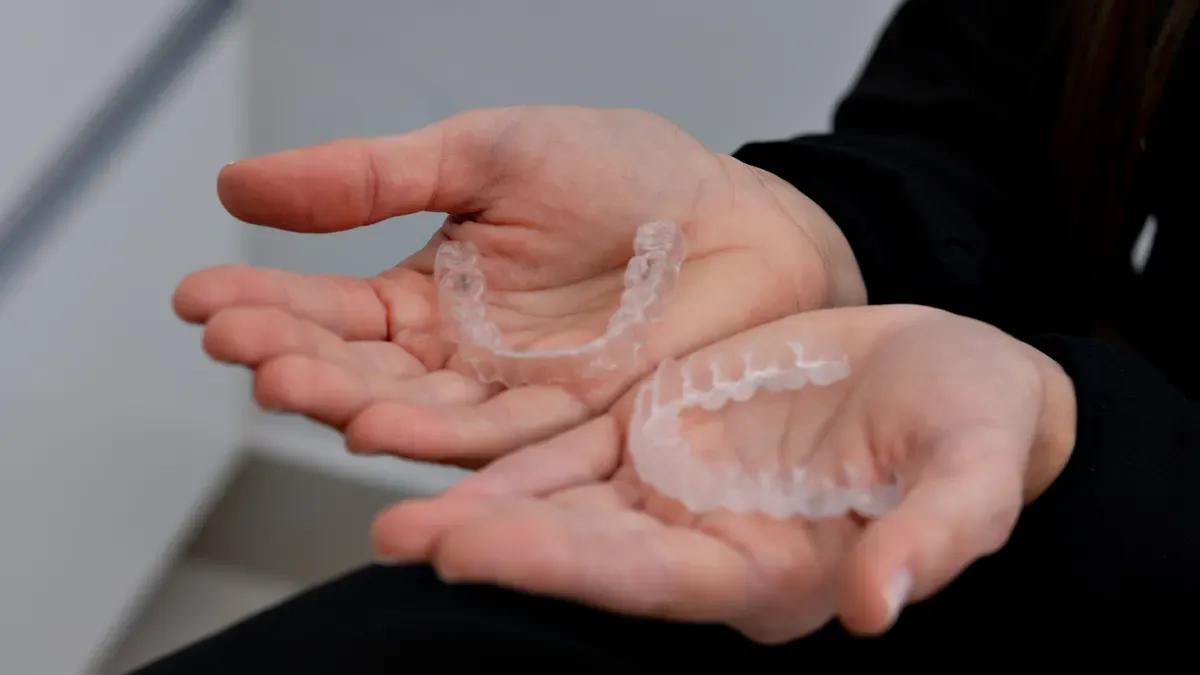
What Does a Standard Aligner Mean?
The term "standard aligner" can have different meanings depending on the manufacturer.
In general, a standardized aligner solution involves more predefined specifications and less case-by-case customization. This may be suitable for applications where the required level of personalization is limited.
However, buyers should not rely solely on the terminology used by a supplier.
When comparing products, ask the manufacturer:
-
Is the aligner based on individual patient data?
-
Is treatment planning included?
-
Can the dentist review the treatment plan?
-
Can the production specifications be customized?
-
What materials are available?
-
Can the supplier provide custom packaging?
-
Is OEM or ODM support available?
These questions give a clearer picture of what the supplier is actually offering.
Why Customization Matters in Clear Aligner Production
The main advantage of a custom production workflow is that each case can be handled according to its own treatment requirements.
This is particularly relevant for dental clinics that routinely submit patient-specific cases.
The manufacturer needs to manage more than the physical production of plastic appliances. It must also connect the patient's digital or physical records with treatment planning and manufacturing.
Midway Dental Laboratory describes its service as a one-stop process covering treatment planning, 3D printing models, and thermoforming. The company also states that it has more than five years of experience with clear aligners.
This type of integrated workflow can reduce the need for a clinic to coordinate different suppliers for different production stages.
Digital Workflow Is an Important Difference
Digital dentistry has changed how custom aligners are produced.
Instead of relying entirely on traditional physical models, dental laboratories can work with digital scan files and computer-based treatment planning.
For a dental clinic, the process can therefore become:
Scan → Upload → Treatment Plan → Review → Approve → Manufacture
Midway uses CAD/CAM technology in its workflow and identifies 3Shape Ortho Analyzer as its staging software.
The practical value of this type of workflow is that case information can move more efficiently from the clinic to the laboratory.
For overseas customers, digital communication can also make it easier to manage cases without physically shipping every type of dental record.
Manufacturing Is More Than Thermoforming
Thermoforming is an important part of clear aligner production, but it is only one step.
A professional custom aligner workflow requires multiple stages to work together.
The laboratory may need to:
-
Check incoming patient data.
-
Prepare the treatment plan.
-
Confirm the plan with the customer.
-
Produce the required 3D models.
-
Thermoform the selected material.
-
Trim the aligner according to the agreed specifications.
-
Inspect the finished appliance.
-
Package the completed case.
Midway identifies its treatment planning, 3D model printing, and thermoforming process as a one-stop solution. The company also specifies its aligner trimming method and provides customers with material options.
For a B2B buyer, this production chain is often more important than simply asking whether a supplier can "make clear aligners."
Material Selection Can Be Important for Buyers
Material is another point worth discussing before starting long-term cooperation.
Different dental laboratories may use different thermoforming materials. A clinic or distributor should confirm the available options and determine whether the supplier can consistently manufacture according to the agreed material specification.
Midway states that it offers Erkodent and SCHEU Duran+ materials, both from Germany, and allows customers to choose which material to use.
This provides buyers with a specific material-selection point to discuss rather than relying on a general statement such as "premium material."
For distributors and dental brands, material consistency can also be important when maintaining the same product specifications across repeated orders.
Custom Packaging for Dental Brands
Custom aligners are not only relevant to dental clinics.
Many international dental businesses also operate as distributors, private-label brands, or orthodontic service providers. In these cases, packaging can become part of the overall product strategy.
A supplier may need to provide:
-
Custom packaging
-
Customer-specific labeling
-
Case identification
-
Brand-related packaging requirements
-
OEM production
-
ODM support
Midway states that it can provide custom packaging when customers supply a sample and also offers OEM/ODM solutions for clear aligner outsourcing.
For a company building its own clear aligner service, this type of manufacturing support can allow the business to focus more on its market and customer relationships while outsourcing production to an established dental laboratory.
Custom Aligners for Overseas Dental Businesses
International sourcing introduces another consideration: communication.
A dental laboratory may be located thousands of miles away from the clinic, so the workflow needs to be clear.
Before cooperation begins, an overseas buyer should understand:
How do I submit a case?
The supplier should explain accepted file formats and whether physical impressions are supported.
How do I approve the treatment plan?
The buyer should know when the treatment plan is sent for review and how modifications are communicated.
What happens after approval?
The manufacturer should have a clear production and shipping process.
Can the product specifications remain consistent?
This becomes increasingly important when a distributor or dental chain starts placing repeated orders.
Midway's website states that its products are exported to more than 80 countries and regions, while its company profile reports customers in markets including Australia, Israel, the United States, Malaysia, Indonesia, and Europe.
International experience can therefore be an important factor when evaluating a Chinese dental laboratory for long-term cooperation.
Custom Aligners vs Standard Aligners: A Practical Comparison
For B2B buyers, the difference can be summarized as follows:
Factor Custom Aligners Standardized Solutions Patient data Individual case data More predefined specifications Treatment planning Case-specific May be more limited Manufacturing Customized workflow More standardized workflow Material options Can be discussed according to supplier Often based on fixed specifications Packaging Can support customization Usually more standardized OEM/ODM Suitable for customized business models Depends on supplier Digital workflow Commonly integrated Depends on product Best fit Clinics, orthodontic businesses, dental brands Applications with simpler requirements This table should be used as a general purchasing framework rather than a clinical recommendation. Actual product specifications vary from one manufacturer to another.
Why Factory and Laboratory Capabilities Matter
When choosing an overseas supplier, buyers should look beyond a product catalog.
The supplier's manufacturing workflow directly affects how efficiently a case can move from treatment planning to finished product.
Midway Dental Laboratory was founded by Mr. William Yin and is based in Shenzhen, China. The company was established in 2016 and describes itself as a full-service dental laboratory. Its product range includes clear aligners, orthodontic appliances, clip-on veneers, crowns and bridges, veneers, all-ceramic restorations, implants, dentures, and metal frameworks.
The company reports more than 20 products, customers in more than 10 export areas, and more than 50 clients on its company profile.
For B2B customers, having multiple dental product capabilities under one laboratory can be useful when sourcing needs expand beyond clear aligners.
A Practical Checklist Before Choosing a Supplier
If you are currently comparing custom aligner manufacturers, consider asking the following questions before placing regular orders:
1. Can the supplier handle my digital workflow?
Check whether it accepts the scan files used by your clinic and whether its treatment-planning workflow is clearly defined.
2. Can physical impressions also be accepted?
This can be useful if your business works with clinics using different workflows.
3. Which materials are available?
Ask for the exact material brands and specifications rather than relying on general descriptions.
4. How is treatment approval handled?
Understand when the treatment plan is submitted for confirmation and how revisions are managed.
5. What are the production stages?
A transparent manufacturer should be able to explain its process from model production through thermoforming and finishing.
6. Can packaging be customized?
This is particularly relevant to private-label dental businesses and distributors.
7. Does the supplier support OEM or ODM?
If you are developing your own aligner brand, this should be clarified before cooperation begins.
8. Does the laboratory have international experience?
Export experience can help indicate whether the supplier is familiar with overseas case communication and shipping requirements.
Custom Aligners Are a Manufacturing Partnership, Not Just a Product
For dental clinics and orthodontic businesses, choosing custom aligners is not simply a question of selecting one transparent appliance over another.
The real difference can be found in the workflow behind the product.
A strong custom aligner process connects patient data, treatment planning, digital modeling, material selection, thermoforming, finishing, inspection, packaging, and international delivery.
That is why supplier evaluation should focus on the entire production system.
Midway Dental Laboratory combines clear aligner production with digital treatment planning, 3D model production, thermoforming, material selection, custom packaging, and OEM/ODM support. Its Shenzhen-based laboratory has been serving international customers since 2016.
For dental clinics, distributors, and orthodontic brands looking for a China-based manufacturing partner, you can learn more about Midway Dental Laboratory through its official website.
Before starting a long-term partnership, it is still important to discuss your specific case workflow, material requirements, treatment-planning process, packaging specifications, and quality expectations directly with the manufacturer.
The better these details are defined at the beginning, the easier it is to establish a repeatable custom aligner production process for international dental business.
http://www.aligner-company.com
Midway Dental Laboratory -
-
AuthorPosts

- You must be logged in to reply to this topic.