
- This topic is empty.
-
AuthorPosts
-
29/09/2026 at 10:32 #8129
Remote base stations are expected to keep communications services running even when they are located far from an operations centre, exposed to harsh weather, or dependent on unstable local power. For telecom operators and infrastructure integrators, monitoring these sites is therefore not simply a matter of checking whether a cellular signal is available. The monitoring network itself must remain dependable enough to report equipment status, power conditions, environmental changes, and alarms.
An industrial 5G router for remote base station monitoring can provide the communications link between site equipment and a central network management or remote supervision platform. With suitable industrial hardware, secure VPN connectivity, redundant cellular links, remote management, and support for field interfaces, the router can become part of the site’s monitoring infrastructure rather than just an internet gateway.
This distinction matters as base station deployments become more distributed. The number of remote sites can make physical inspection impractical, while site-level information needs to reach the network operations team quickly enough to support fault diagnosis and maintenance decisions.
Remote Base Station Monitoring Is About More Than Network Status
A base station site contains much more than radio equipment.
Depending on the site configuration, monitoring may involve DC power systems, batteries, rectifiers, environmental sensors, cooling equipment, alarms, access systems, and communication equipment. Modern telecom-site monitoring frameworks also place emphasis on exchanging measurements, warnings, alarms, configuration information, and logs between site equipment and higher-level network management systems. ITU-T L.1395, published in 2025, specifically addresses monitoring and control interfaces for power, cooling, and building-environment systems at telecommunications sites.
This creates a layered monitoring requirement.
Equipment status
The operations team may need to know whether site equipment is online, whether a fault has occurred, and whether a particular subsystem has entered an abnormal state.
Power conditions
Voltage, current, energy consumption, battery conditions, or power-related alarms can provide useful information about the site’s operating condition. ITU-T’s recent telecom monitoring recommendations include power and energy measurements as part of the information that can be transferred to network operation and management systems.
Environmental conditions
Temperature and humidity can affect equipment performance and maintenance requirements. Environmental alarms may therefore need to be transmitted together with equipment and power data.
Event and alarm information
A monitoring platform is more useful when it can distinguish normal measurements from abnormal events. ITU-T L.1395 includes alarm and event concepts for conditions such as hardware, software, temperature, humidity, and power-related abnormalities.
The communication gateway must therefore support more than simple internet access. It needs to provide a stable path for a variety of operational information.
Why Use 5G as the Remote Monitoring Backhaul?
Base station locations are not always easy to connect through conventional fixed networks.
A remote site may be positioned on a tower, rooftop, roadside structure, rural property, industrial compound, or another distributed location. In some deployments, a fixed connection can be difficult to install or may not fit the project’s network architecture.
5G cellular connectivity provides an alternative wireless backhaul for connecting monitoring equipment to central systems.
The main advantage is flexibility. A system integrator can establish a communications path without redesigning the entire physical network around a new fixed line.
However, the real benefit of a 5G router is not simply higher headline speed. Base station monitoring typically requires a combination of stable connectivity, secure remote access, device integration, and centralized management.
An industrial router should therefore be selected according to the monitoring architecture and site conditions rather than cellular speed alone.
The Router Has to Work With Existing Site Equipment
Telecom sites often contain equipment from different generations. A newly deployed communications gateway may need to coexist with existing monitoring devices, controllers, meters, or sensors.
This is where interfaces and protocols become important.
E-Lins supports Modbus, TCP/IP, and industrial serial transparent transmission within its industrial communication portfolio. This allows its networking equipment to be incorporated into architectures where industrial devices communicate over Ethernet or serial interfaces.
A typical architecture could be:
Site sensors and equipment → Local monitoring or control system → Industrial router → 5G network → NMS or remote supervision platform
In some projects, the router may connect directly to networked monitoring equipment. In others, it may provide the communications path for a local controller or edge gateway that aggregates data from several devices.
This separation is useful because it avoids expecting the router to perform every monitoring function itself. The router provides the communications infrastructure, while the site’s monitoring software handles equipment-specific data processing.
Dual SIM Helps Address Cellular Connectivity Failures
A remote monitoring system can still become unreachable when the cellular connection fails.
This is particularly important at unattended sites. A technician may not know whether the base station has a genuine equipment fault or whether the communication link has simply disappeared.
E-Lins’ industrial 5G architecture includes dual SIM hot backup on the H900f. The concept is to maintain a primary mobile connection while keeping another cellular path available for failover.
For remote base station monitoring, this can create a more resilient communication architecture:
Function Typical role SIM 1 Primary cellular connection SIM 2 Backup cellular connection VPN Secure connection to central systems Ethernet Local connection to monitoring equipment NMS Centralized device management A second SIM should not be confused with automatically doubling bandwidth. Its main value in this application is providing another connectivity path when the preferred mobile connection becomes unavailable.
The failover rules should be configured around the actual service that needs to recover. For example, the router may need to detect not just loss of cellular registration, but the loss of the application or VPN path used by the monitoring system.
Remote Base Stations Put More Demands on Hardware
A communications router installed in a telecom site may operate continuously and may be exposed to temperature fluctuations or electrical disturbances.
E-Lins specifies industrial-grade components with a -35°C to +75°C operating temperature range, 15KV ESD protection, and 1.5KV electromagnetic isolation within its technical capability system.
These specifications are relevant when a router is installed in a field cabinet or remote infrastructure location rather than in a controlled office or data-centre environment.
Power design can also matter. The E-Lins H900f supports wide DC input options and dual power inputs, allowing projects to design for redundant power sources where the installation requires it.
This is worth considering because the router itself becomes part of the monitoring chain. If the gateway loses power, the remote monitoring system may lose visibility at exactly the moment the site is experiencing a power-related event.
In other words, connectivity reliability and power reliability should be considered together.
Secure Remote Access for Maintenance Teams
Remote monitoring often needs to go beyond receiving status information.
A network engineer may need to access a site remotely to diagnose a communication issue, inspect device settings, or troubleshoot an industrial controller.
Opening individual devices directly to the public internet is generally not an appropriate architecture for a critical infrastructure environment. A more controlled approach can use VPN tunnels and access policies.
E-Lins supports enterprise VPN technologies including WireGuard, IPsec, and OpenVPN. Its industrial routers also support management methods such as SSH, SNMP, TR-069, and NMS connectivity.
These functions can help create a managed communications environment between the remote site and authorized operations personnel.
The final security architecture should still be determined by the operator’s IT and OT requirements. Router-level VPN capability is one part of the overall design and does not replace network segmentation, authentication, access control, logging, and other security measures.
Centralized Management Becomes Essential at Scale
A single remote base station can potentially be managed through direct access. A large network of sites requires another approach.
E-Lins provides an NMS cloud platform for centralized monitoring, configuration, updating, diagnosis, maintenance, management, and control of distributed communication terminals. It also supports TR-069, SNMP, SSH, and other management methods.
This changes the maintenance workflow.
First, identify the scope of the problem
When a site becomes unreachable, engineers can first check the router’s status rather than immediately dispatching a technician.
Then separate network faults from site faults
A base station may be operational while its monitoring connection is down. Remote router information can help narrow down the possible causes.
Standardize configurations
When routers are deployed across many sites, consistent configuration becomes easier to maintain through centralized tools.
Maintain the installed fleet
Firmware updates and remote technical assistance can be handled more systematically than through site-by-site intervention.
This approach becomes especially important for tower operators, telecom integrators, and service providers managing geographically dispersed installations.
A Real E-Lins Telecom Deployment Shows Why Site Reliability Matters
E-Lins has experience supporting large-scale telecom infrastructure deployments.
In one documented case involving an Indian telecom operator, the monitored base stations were located in areas with unstable power conditions ranging from 5V to 55V and ambient temperatures reaching 48°C. E-Lins supplied more than 100,000 units for the project.
The reported results included a 99.4% equipment online rate, a 53% reduction in per-site maintenance costs, and an 82% improvement in batch management efficiency across the supplied deployment.
These figures are specific to that project and should not be interpreted as guaranteed results for every telecom network. What the case demonstrates more practically is the importance of matching the communications hardware to the conditions of an unattended base station deployment.
The same principle applies when an operator evaluates a new 5G monitoring architecture: environmental conditions, power configuration, cellular coverage, network redundancy, remote management, and field integration all need to be considered together.
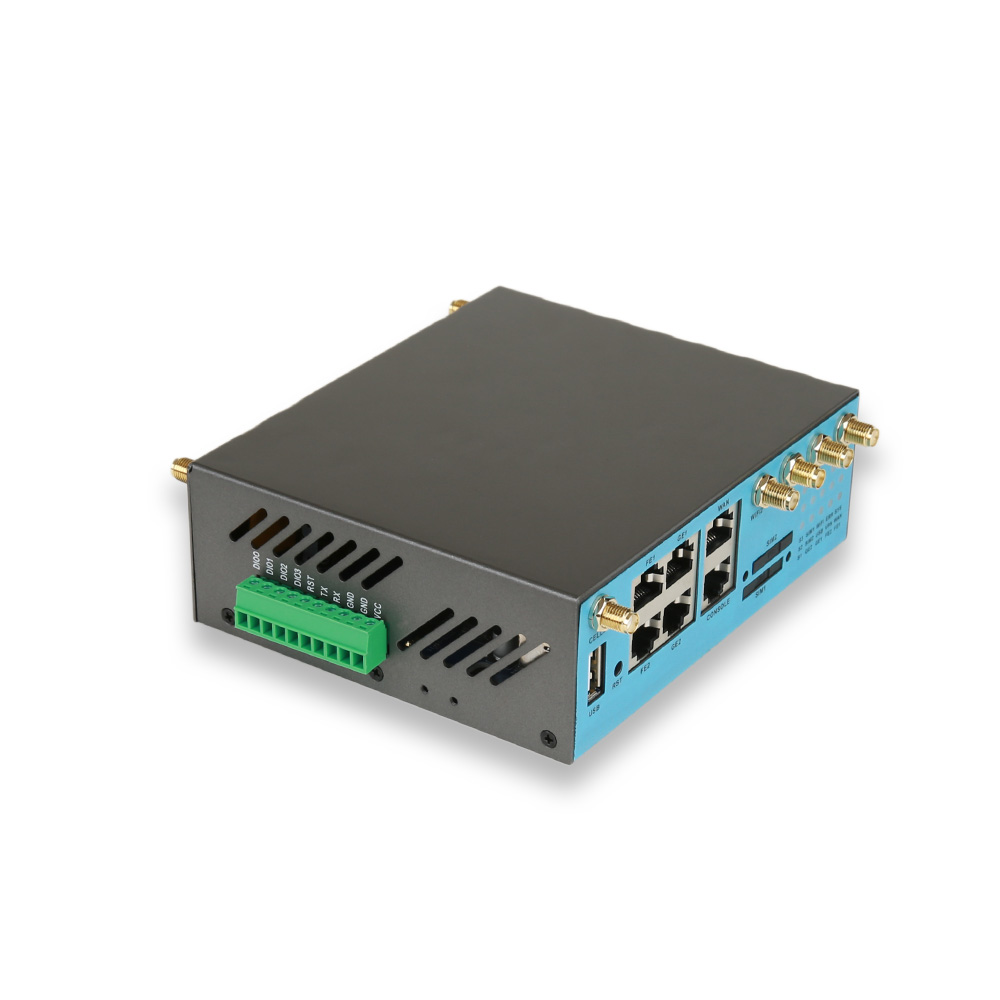
H900f as an Industrial 5G Gateway for Remote Base Station Monitoring
Within the E-Lins portfolio, the H900f Gigabit 5G Industrial Router is designed for high-bandwidth industrial IoT connectivity and can serve as the communications gateway for remote monitoring architectures.
Its relevant capabilities include:
Monitoring requirement E-Lins H900f capability 5G connectivity 5G SA/NSA dual-mode Cellular redundancy Dual SIM hot backup Local device networking Gigabit Ethernet Field-device integration Industrial networking interfaces Remote access security VPN technologies Device management NMS, SNMP, SSH, TR-069 Harsh environments Industrial wide-temperature design Installation flexibility Desktop, wall-mount and DIN-rail options The H900f can therefore connect local monitoring equipment to a remote operations platform while providing the network management and redundancy features required for distributed industrial communication.
The product can also support PoE++ for compatible Ethernet devices. This can be useful when additional network equipment needs to be connected and powered in the same remote cabinet or field installation.
What Data Should a Remote Base Station Monitoring Network Carry?
The exact monitoring dataset depends on the operator and site architecture, but the communications network may need to transport several categories of information.
Equipment telemetry
Status information from communications and supporting infrastructure can provide visibility into normal site operation.
Power and battery information
Measurements and alarms related to voltage, current, energy, and battery conditions can help engineers understand whether a site problem originates from its power system. Recent ITU-T recommendations specifically cover the exchange of power, energy, environmental, inventory, configuration, and alarm information at telecom sites.
Environmental data
Temperature and humidity measurements can be correlated with equipment alarms or site conditions.
Event logs
Historical events help engineers determine what happened before a failure rather than seeing only the current status.
Network information
The router itself can report connectivity conditions, traffic statistics, and communication status, helping engineers distinguish a site equipment fault from a WAN problem.
This is where a robust communication gateway becomes valuable: it carries and exposes the information needed by the monitoring system without becoming the only source of site intelligence.
How to Design the Network for Unattended Sites
A practical remote base station architecture should define the failure modes before deployment.
For example, engineers should ask what happens when:
The primary SIM loses service: Can the router switch to a secondary cellular path?
The monitoring server becomes unreachable: Can the router distinguish a WAN problem from a local equipment problem?
The router itself freezes: Is there a hardware watchdog or other recovery mechanism?
The site loses its primary power supply: Can the communications equipment remain powered through the available backup arrangement?
A field device stops responding: Can engineers determine whether the issue is with the device, serial/Ethernet link, router, VPN, or cellular network?
E-Lins incorporates link self-healing mechanisms and hardware watchdog timers into its technical capability system. These functions are relevant to unattended deployments because automatic recovery can reduce the number of situations that require physical intervention.
The purpose is not to assume every failure will recover automatically. Instead, the network should be designed so that common communication failures can be detected, isolated, and recovered with as little on-site intervention as practical.
Why Remote Management and Physical Reliability Need to Be Designed Together
It is easy to focus on software features when selecting a remote monitoring gateway. In practice, the physical installation can be just as important.
A router with extensive management capabilities is of limited value if its hardware cannot tolerate the site’s operating conditions. Conversely, rugged hardware cannot provide much operational value if the operator cannot manage hundreds of deployed units efficiently.
For remote telecom infrastructure, a useful industrial router therefore combines several layers:
Industrial hardware + reliable cellular connectivity + network redundancy + secure remote access + centralized management
That combination addresses the actual operating problem instead of treating the router as a simple data connection.
Choosing an Industrial 5G Router for a Base Station Project
Before selecting equipment, telecom operators and system integrators should document the site requirements.
First, determine the data sources and interfaces. Identify whether the monitoring system uses Ethernet, serial communication, Modbus, TCP/IP, or another protocol.
Next, review the power architecture. The router’s voltage requirements should match the available DC power system, and redundant power inputs can be considered where continuity is important.
Then evaluate the cellular environment. 5G coverage should be checked at the actual base station location, while 4G fallback and dual-SIM requirements should be evaluated according to the operator’s network architecture.
The environmental specification also needs to match the installation location, especially for outdoor or unconditioned cabinets.
Finally, define how the deployed fleet will be managed after commissioning. A network that works during installation but requires frequent on-site intervention will create a very different maintenance burden from one that can be centrally monitored and remotely diagnosed.
Conclusion
Remote base station monitoring is ultimately a connectivity and visibility challenge.
The monitoring platform needs timely access to equipment status, power conditions, environmental information, alarms, logs, and network data. At the same time, the communication gateway must operate reliably at remote sites where temperature, power quality, and physical access may be very different from those found in a conventional IT environment. Telecom monitoring standards increasingly recognize the importance of structured exchange of power, environmental, alarm, and configuration information between site equipment and remote management systems.
An industrial 5G router for remote base station monitoring can provide the communications layer connecting this site information with a centralized operations environment.
E-Lins Technology focuses on industrial M2M and IoT wireless communication equipment for unattended and distributed applications. Shenzhen E-Lins Technology Co., Ltd., established in Shenzhen in 2012 with industrial roots dating back to 1999, serves customers across more than 150 countries and regions. Its product portfolio covers industrial 4G and 5G routers, industrial modems and DTUs, with applications across telecommunications, power and energy, transportation, industrial automation, environmental monitoring, and smart-city infrastructure.
For telecom operators and system integrators, the practical selection criteria are clear: the router needs to fit the site’s power system, communicate with the installed monitoring equipment, provide secure and redundant connectivity, tolerate the operating environment, and remain manageable after hundreds or thousands of units have been deployed.
That is what turns a cellular router into a useful part of a remote base station monitoring system.
https://e-lins.com/
Shenzhen E-Lins Technology Co., Ltd. -
AuthorPosts

- You must be logged in to reply to this topic.