
- This topic is empty.
-
AuthorPosts
-
12/10/2026 at 18:09 #8231
Why Does Football Stadium Lighting Matter for Modern Football?
Football is watched by millions of fans through television, online streaming, and digital highlights. For professional stadiums, lighting must do more than illuminate the pitch. It must also help cameras capture players clearly, maintain consistent image quality, and support slow-motion replays.
A football pitch may appear bright to spectators while still presenting challenges for television production. Uneven illumination, insufficient vertical illuminance, inconsistent color rendering, and flicker can all affect the final broadcast image.
For stadium owners, lighting designers, and engineering contractors, these factors should be considered from the earliest stages of a new construction or renovation project.
Here are five essential considerations when designing LED football stadium lighting for professional competition and television broadcasting.
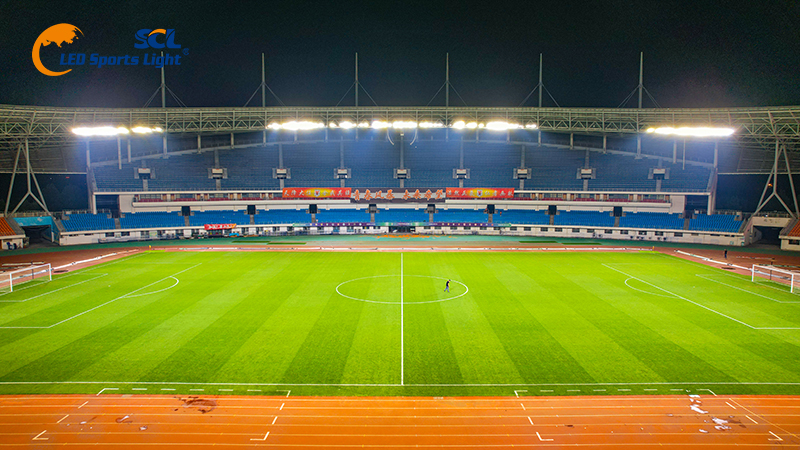
1. Achieve the Required Illuminance and Uniformity
Horizontal illuminance is one of the fundamental parameters in football pitch lighting design. It measures the amount of light reaching the playing surface.
However, a high average illuminance does not automatically mean the entire pitch is adequately illuminated.
If some areas are significantly brighter than others, players and the ball may appear differently illuminated as play moves across the field. These variations can also affect the consistency of broadcast images.
A professional lighting design should evaluate:
· Average horizontal illuminance: Whether the pitch receives sufficient light for the intended competition level.
· Minimum illuminance: Whether darker areas remain within the specified limits.
· Illuminance uniformity: Whether light is distributed consistently across the playing area.
· Maintenance factor: Whether the design accounts for expected light output depreciation over time.
The required values depend on the competition category, applicable standards, and broadcast specifications. A training ground and a stadium hosting major televised matches may require different lighting configurations.
For this reason, lighting designers should use photo metric calculations to determine fixture quantities, mounting heights, aiming angles, and beam distributions rather than relying on rated wattage alone.
2. Prioritize Vertical Illuminance for TV Cameras
Horizontal illuminance helps ensure that the pitch surface is visible, but television cameras also need to capture players from different directions.
This is where vertical illuminance becomes important.
Vertical illuminance measures the light falling on a vertical plane. In football stadiums, suitable vertical illumination helps cameras capture players’ faces, jerseys, and movements clearly.
If vertical illuminance is insufficient or uneven, players may appear darker from certain camera positions even when the pitch surface looks adequately illuminated.
To address this, lighting designers should consider:
· Main camera positions and shooting directions.
· Vertical illuminance requirements for relevant camera views.
· The balance between horizontal and vertical illumination.
· Fixture aiming angles and light distribution.
· Potential shadows and brightness differences across the pitch.
The design should be coordinated with the intended competition and broadcast requirements. A lighting layout that performs well from the main stand may not deliver the same results from every camera angle.
Planning these requirements early can help reduce the need for costly adjustments after installation.
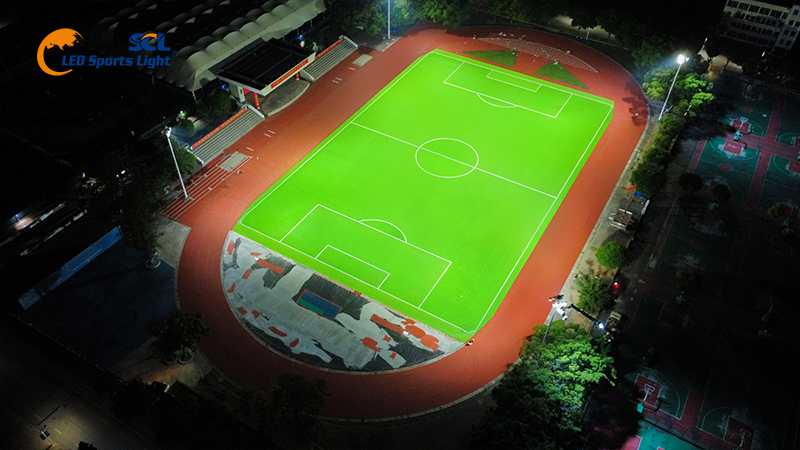
3. Select LED Sports Floodlights With Suitable Color Rendering
Color quality plays an important role in the visual presentation of televised football.
Players’ skin tones, team uniforms, the green pitch, and advertising boards should appear natural and consistent. This becomes especially noticeable in close-up shots, replays, and high-definition broadcasts.
When evaluating LED football stadium lights, project teams should consider several factors.
Color Rendering Index (CRI)
CRI is a common indicator of how accurately a light source renders colors compared with a reference source. It is useful for product evaluation, although it should not be the only measure of broadcast color performance.
Color consistency
Differences between lights can produce noticeable variations in color across the pitch. Consistent color characteristics help maintain a more uniform visual environment.
Correlated color temperature (CCT)
CCT influences the perceived warmth or coolness of light. The appropriate specification should be selected according to the venue’s requirements and coordinated with the broadcast team.
For major stadium projects, these characteristics should be evaluated alongside illuminance, uniformity, and camera requirements. The final broadcast image also depends on camera sensors, white balance, and production settings, so lighting specifications should form part of an integrated technical plan.
4. Control Flicker for Slow-Motion Replays
Slow-motion footage is now a standard feature of professional football broadcasts. Goals, saves, tackles, and controversial moments are frequently replayed at high frame rates.
Under certain operating conditions, LED sports lighting can interact with camera shutter settings and produce visible flicker or banding in recorded footage.
This means stadium lighting should be evaluated not only for its appearance to the naked eye but also for its performance under broadcast recording conditions.
Important considerations include:
· LED driver performance and electrical stability.
· Flicker characteristics at full output and reduced dimming levels.
· Compatibility with the intended camera frame rates and shutter settings.
· Performance during high-speed recording.
· Lighting stability when switching between operating scenes.
For stadiums hosting televised matches, the selected LED sports floodlights should meet the applicable flicker requirements and be tested under relevant operating conditions when necessary.
Dimming systems deserve particular attention. A lighting system may perform differently at reduced output than it does at full power, so testing only at maximum brightness may not be sufficient.
Coordinating with the broadcast production team helps ensure that the proposed system supports the venue’s actual filming requirements.
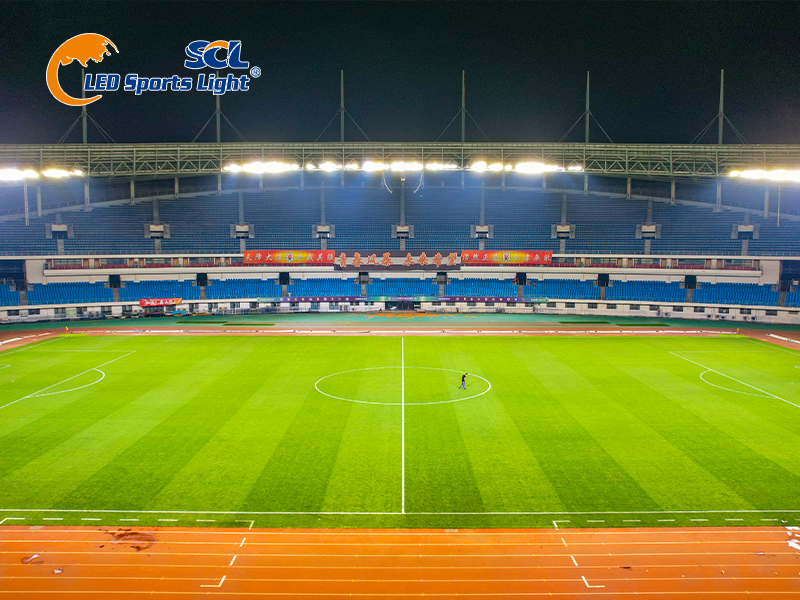
5. Optimize Floodlight Positioning, Glare Control, and Energy Efficiency
Even high-quality LED stadium floodlights cannot guarantee good results if their positions and aiming angles are poorly planned.
The lighting design must consider the geometry of the pitch, mounting height, beam distribution, viewing directions, and surrounding environment.
A well-designed layout should balance:
· Required horizontal and vertical illuminance.
· Consistent lighting across the playing area.
· Glare control for players, officials, and spectators.
· Reduced unwanted light spill beyond the stadium.
· Efficient use of electrical power.
· Practical maintenance and long-term reliability.
Glare control is especially important when players look toward high balls, crosses, and goalmouth action. Fixture placement and optical design should minimize uncomfortable views of bright lights without compromising the required pitch illumination.
For outdoor stadiums, designers should also consider nearby residential areas and other light-sensitive surroundings.
Modern LED sports floodlights offer different optical distributions to suit varying mounting conditions and pitch geometries. Intelligent lighting controls can further support different operating modes, such as televised matches, non-broadcast competitions, training, and maintenance.
The final configuration should be verified through lighting simulation before installation, followed by on-site measurements and aiming adjustments.
What Should Stadium Owners Check Before Purchasing LED Football Stadium Lights?
Selecting football stadium lighting should begin with the project requirements, not simply a comparison of fixture wattage or purchase prices.
Before confirming equipment specifications, stadium owners and contractors should review the following checklist:
· Competition level: Identify the applicable lighting standards and broadcast category.
· Photo–metric performance: Check illuminance, uniformity, and vertical illuminance calculations.
· Broadcast requirements: Confirm color quality and flicker performance.
· Optical configuration: Evaluate beam distribution, mounting positions, and aiming angles.
· Control system: Determine whether different operating modes or dimming functions are required.
· Installation conditions: Assess mounting structures, electrical infrastructure, and maintenance access.
· Long-term operating costs: Consider energy consumption, maintenance requirements, and expected service life.
The most suitable fixture is not necessarily the one with the highest wattage or the lowest purchase price. It is the one that helps the complete lighting system meet the project’s performance requirements with an appropriate operating and maintenance strategy.
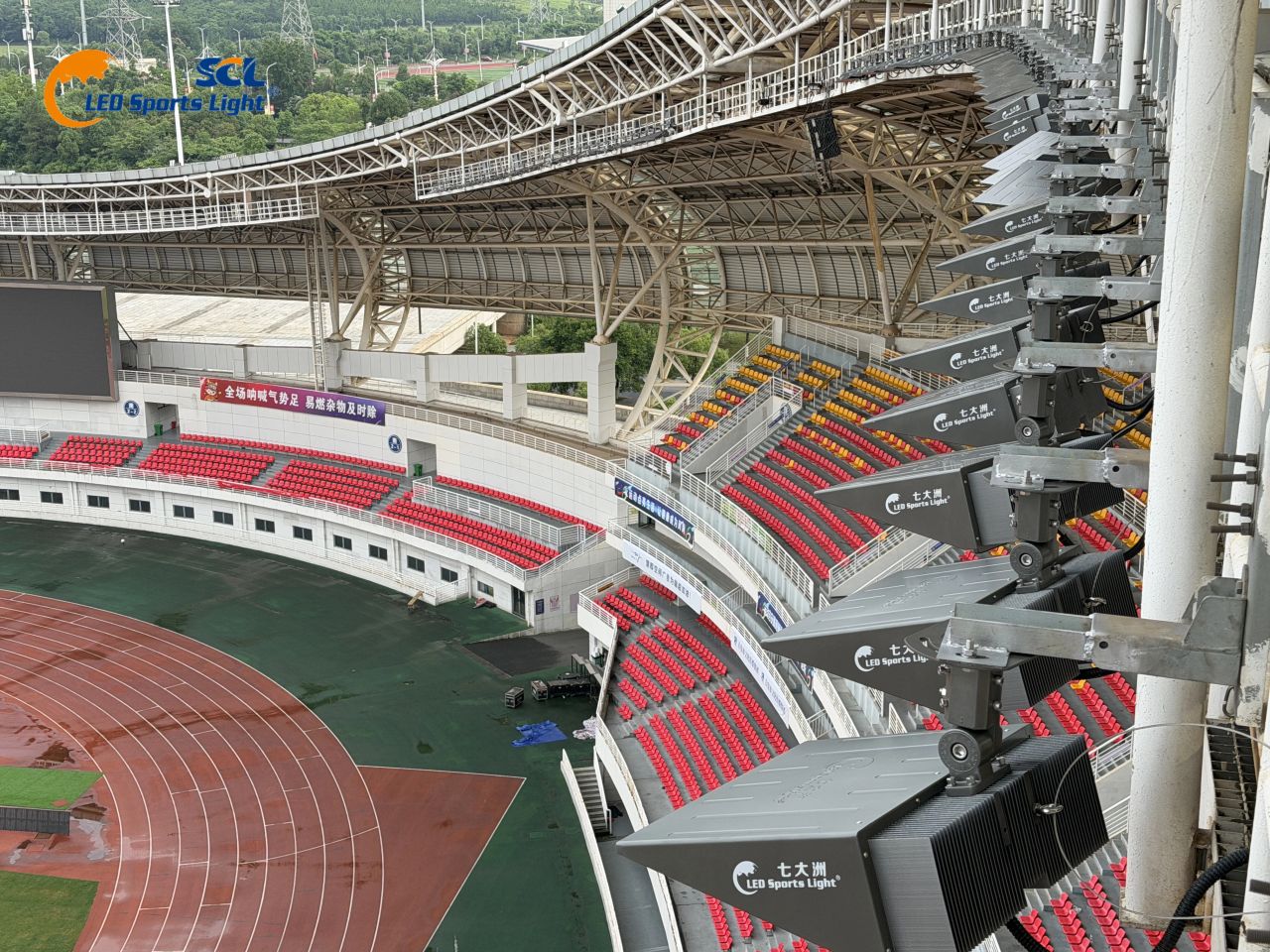
How SCL Sports Lighting Supports Football Stadium Projects
Professional football stadium lighting requires coordination between LED sports fixtures, optical design, lighting calculations, installation conditions, and broadcast requirements.
SCL Sports Lighting provides LED sports lighting solutions for stadiums and other sports facilities with different performance and operational needs.
For football stadium projects, a suitable lighting design should account for pitch dimensions, competition category, mounting height, illuminance and uniformity targets, camera positions, glare control, and operating modes.
Combining project-specific photo–metric calculations with appropriate LED sports floodlights helps engineers develop a lighting system around the venue’s actual requirements rather than relying on fixture specifications alone.
Whether upgrading an existing stadium or developing a new football facility, a detailed lighting assessment is an important first step toward achieving reliable performance.
Planning a football stadium lighting project? Contact SCL Sports Lighting to discuss your pitch dimensions, mounting conditions, broadcast requirements, and LED sports lighting design objectives.
https://www.stadiumlight.com/
GUANGDONG SEVEN CONTINENTS INDUSTRIAL CO., LTD -
AuthorPosts

- You must be logged in to reply to this topic.