
- This topic is empty.
-
AuthorPosts
-
16/11/2026 at 20:09 #8708
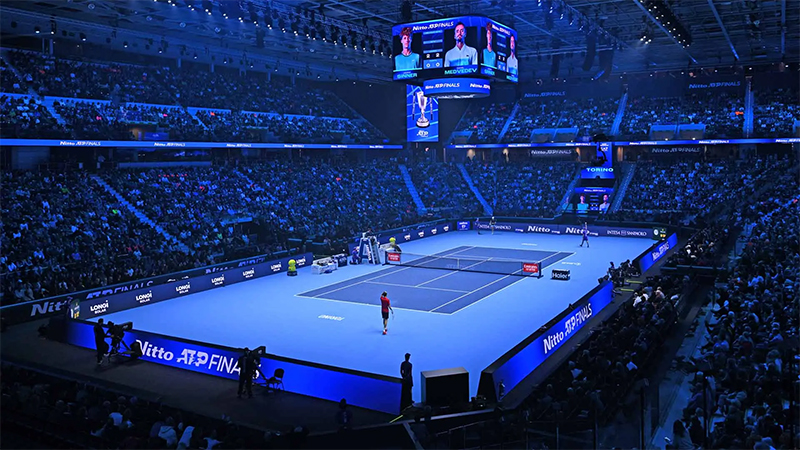
The 2026 Nitto ATP Finals in Turin once again brings the world’s top tennis players together for the season-ending championship. Held at the Inalpi Arena from November 15 to 22, the tournament is played on indoor hard courts, highlighting the importance of a well-designed indoor sports environment.
While players and fans focus on the competition, there is another important element behind every professional indoor tennis event: the lighting system.
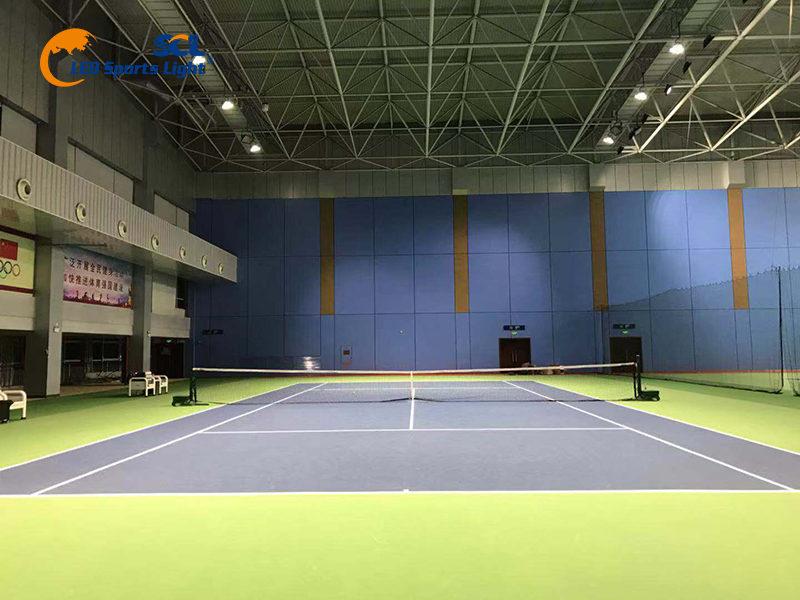
Unlike outdoor tennis courts, indoor facilities operate within an enclosed architectural environment. Ceiling structures, mounting heights, player viewing angles, reflective surfaces, and television broadcasting requirements all influence the lighting design.
So, what makes professional indoor tennis court lighting different, and what should venue owners consider when planning a new facility or upgrading an existing one?
1. Ceiling Height and Structural Limitations
One of the biggest differences between indoor and outdoor tennis lighting is the installation environment.
Outdoor courts generally allow greater flexibility in pole positioning and mounting height. Indoor courts, however, must work within the existing building structure.
Lighting designers need to consider:
-
Roof and ceiling height.
-
Structural beams and trusses.
-
Available mounting positions.
-
Ventilation systems and other ceiling equipment.
-
The distance between luminaires and the playing surface.
-
Maintenance and access requirements.
If luminaires are installed too low or positioned poorly, they may create uncomfortable glare or uneven illumination.
If they are installed too high, the optical distribution and fixture output must be carefully evaluated to ensure sufficient light reaches the playing area.
The correct solution is therefore not simply to maximize mounting height, but to coordinate the building structure, luminaire optics, and lighting layout.
2. Glare Control Is Critical for Tennis Players
Tennis players frequently look upward to follow serves, lobs, and high-speed shots.
In an indoor environment, poorly positioned luminaires can become particularly distracting because the ceiling and lighting equipment are always within the players’ field of vision.
A professional indoor tennis lighting design should consider:
Player viewing directions
Lighting positions should be evaluated in relation to the directions players look when serving, receiving, and tracking high balls.
Luminaire aiming angles
Incorrect aiming may expose players to direct glare or create excessively bright areas.
Optical distribution
Suitable beam distribution helps direct light toward the playing area while limiting unnecessary light outside the intended coverage.
Visual comfort
The goal is to provide consistent illumination without distracting bright spots or uncomfortable contrast.
Importantly, increasing illuminance does not automatically improve playing conditions. A court with excessive brightness in some areas and insufficient illumination in others may still provide a poor visual environment.
3. Uniform Illumination Across the Entire Court
Lighting uniformity is another major consideration for professional indoor tennis facilities.
Players need to follow the ball consistently across the baseline, sidelines, and central playing area. Noticeable brightness differences can affect visual comfort and the overall playing experience.
A professional lighting design should evaluate:
-
Average horizontal illuminance.
-
Minimum and maximum illuminance.
-
Overall illumination uniformity.
-
Lighting distribution across the playing and surrounding areas.
-
Potential shadows and dark zones.
Uniformity should be assessed through photometric calculations rather than visual estimation alone.
The selected luminaires’ actual IES or LDT photometric files should be used in the simulation to evaluate how light is distributed across the court.
For competition venues, the design should also be checked against the applicable tennis competition and broadcasting requirements.
4. Television Broadcasting Adds Another Layer of Complexity
Professional tennis tournaments increasingly depend on high-quality television and digital broadcasting.
For indoor venues, lighting must support not only players but also cameras positioned at different locations around the court.
This means that designers may need to evaluate both horizontal and vertical illuminance.
Horizontal illuminance describes the light reaching the playing surface. It is important for providing adequate visibility across the court.
Vertical illuminance describes the light reaching vertical planes from specified directions. It can be important for camera-facing views of players and for consistent broadcast images.
Other factors, including flicker performance, colour rendering, and lighting stability, should also be considered.
For facilities hosting televised competitions, the lighting design should be developed with the intended camera positions and broadcasting requirements in mind.
Simply meeting a horizontal illuminance target may not be sufficient for a high-level broadcast application.
5. Reflective Surfaces and the Indoor Environment
Indoor sports facilities contain many surfaces that can influence the visual environment.
Roof structures, walls, advertising boards, flooring, and seating areas may all affect how light is perceived within the venue.
Although the main objective is to illuminate the playing area, lighting designers should also consider unwanted reflections and excessive brightness contrasts.
For example:
-
Highly reflective surfaces may create distracting bright areas.
-
Dark roof structures may absorb more light.
-
Large advertising screens may introduce additional brightness contrasts.
-
The colour and reflectance of surrounding surfaces may influence the overall visual environment.
A well-designed system should focus on controlled light distribution rather than simply increasing fixture power.
6. Choosing the Right LED Sports Lighting System
Selecting luminaires for an indoor tennis facility requires more than comparing wattage and lumen output.
Buyers should evaluate several technical factors.
Optical performance
Check the actual beam distribution and whether it suits the mounting height and court layout.
Glare control
Review luminaire positioning, aiming angles, and the relevant glare evaluation.
Colour rendering
Suitable colour rendering helps players, spectators, and cameras distinguish the ball, court, and surrounding environment.
Thermal management
Indoor luminaires still generate heat. Effective heat dissipation is important for maintaining stable operating conditions.
Dimming and control compatibility
Some facilities require different lighting scenes for professional competitions, training, recreational activities, and maintenance.
The selected LED drivers and control equipment should support the intended operating modes.
For larger facilities, control options such as 0–10V, PWM, or DMX512 may be considered depending on the system architecture and equipment compatibility.
7. Why Professional Lighting Simulation Should Come First
Before installing luminaires, venue owners and project contractors should request a project-specific lighting design.
A reliable simulation process normally includes:
-
Collecting accurate court and building dimensions.
-
Reviewing ceiling height and structural constraints.
-
Confirming the required competition and lighting standards.
-
Selecting suitable LED luminaires and optical distributions.
-
Establishing mounting positions and aiming angles.
-
Calculating horizontal and vertical illuminance where required.
-
Evaluating uniformity and glare-related performance.
-
Reviewing the final arrangement before installation.
This process helps identify potential lighting problems before construction or renovation begins.
It also allows engineers to compare different luminaire configurations and adjust the design according to the actual conditions of the venue.
8. SCL Sports Lighting: Experience Across Professional Tennis Venues
Indoor and outdoor tennis facilities require different lighting considerations, but both depend on a carefully engineered combination of optical performance, fixture positioning, and lighting calculations.
SCL Sports Lighting focuses on professional sports lighting solutions for tennis, football, basketball, and other sports facilities.
Its tennis-related project experience includes:
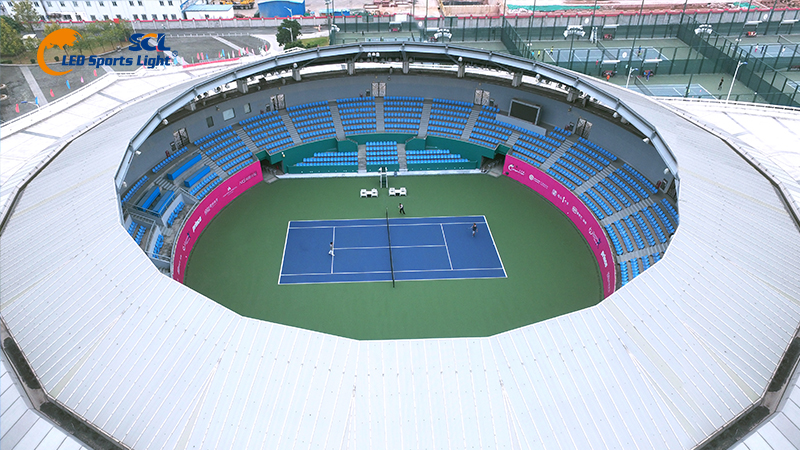
Guangdong Olympic Tennis Center
A venue associated with WTA events and international tennis competitions. According to the project information provided, the lighting system achieved average illuminance above 2,000 lux, U2 of 0.80, and GR no greater than 23.
Sichuan International Tennis Center
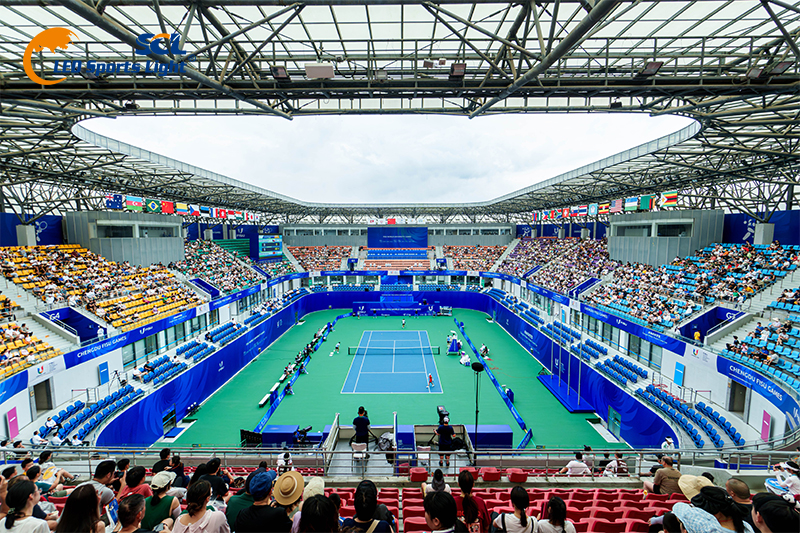
A venue for the 31st FISU World University Games and the Chengdu Open ATP 250.
SCL Sports Lighting’s technical background also includes participation in drafting China’s national standards for LED sports lighting applications and outdoor workplace lighting design.
The company has accumulated more than 300 testing reports, certification documents, and qualification records, according to company-provided information.
These experiences provide useful technical context when evaluating a sports lighting manufacturer. However, every indoor tennis project still requires its own lighting calculations based on the building structure, court dimensions, and intended use.
Conclusion
Professional indoor tennis court lighting is more than installing powerful LED floodlights above the playing area.
Ceiling height, structural limitations, glare control, uniformity, vertical illuminance, camera requirements, and optical distribution all influence the final result.
The 2026 Nitto ATP Finals in Turin provides a timely reminder of the importance of the indoor playing environment in professional tennis.
For venue owners, developers, and engineering contractors, the best approach is to evaluate lighting requirements early and work with a supplier capable of providing project-specific lighting calculations and suitable technical solutions.
A professional indoor tennis venue needs more than sufficient brightness. It needs consistent illumination, visual comfort, and lighting performance designed around the way tennis is played.
https://www.stadiumlight.com/
GUANGDONG SEVEN CONTINENTS INDUSTRIAL CO., LTD -
-
AuthorPosts

- You must be logged in to reply to this topic.