
- This topic is empty.
-
AuthorPosts
-
16/11/2026 at 20:17 #8709
Selecting the right tissue paper for a cosmetic gift set is not simply a matter of color—it directly affects unboxing experience, product protection, and brand perception. Brands sourcing wrapping tissue for beauty packaging face several recurring pain points: ink rub-off, color bleeding onto cosmetic surfaces, tearing during automatic packaging, batch-to-batch color or brightness variation, and paper dust that can contaminate delicate items. Understanding the available tissue categories and their technical characteristics helps packaging buyers make an informed, scenario-appropriate choice.
Starting Point: Base Tissue Construction
Most premium wrapping tissue is built on either an MF (double-sided even finish) or MG (single-sided glossy, reverse matte) base. MF tissue offers uniform smoothness on both sides, meaning no front/back sorting is required during converting—a practical advantage for high-volume cosmetic gift set assembly. MG tissue, by contrast, has a mirror-gloss side suited for bright printing and a matte reverse side that absorbs ink well, along with higher stiffness and tensile strength for automatic packing lines. Both constructions are available in grammage ranging from 14g to 30g depending on the specific product line, with options for virgin wood pulp or recycled pulp bases, and stock colors such as white, cream, and natural kraft, alongside custom Pantone matching.Matching Finish to Brand Positioning
For cosmetic gift sets, the choice of finish often determines the perceived tier of the product line: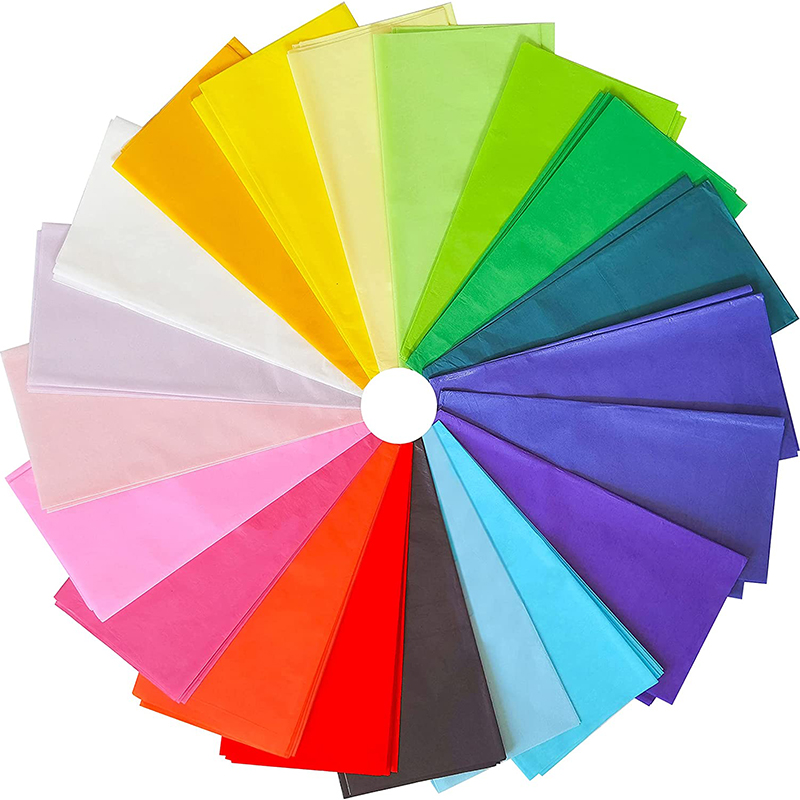
-
Plain Solid Color Tissue: Ideal when the brand wants clean, uniform packaging without additional decoration. Solid color MF or MG tissue provides stable ink absorption, good folding behavior, and low lint, which is particularly relevant for cosmetics, where any fiber shedding onto a product surface is undesirable.
-
Printed Tissue Paper: When brand identity needs to be reinforced at the unboxing moment, custom printed tissue—built on either MF or MG base—allows flexo and offset printing from a simple one-color logo to full-color artwork. A color-fixed base option is available to prevent bleeding, which is especially important for cosmetics packed with ancillary fabric, leather, or metal accessories that could be stained by transferred pigment.
-
Hot Stamping Tissue Paper: For higher-tier cosmetic lines, metallic hot stamping foil—available in bright gold, matte gold, silver, rose gold, copper, and holographic metallic—creates a mirror shine distinctly brighter than printed metallic ink. This option is explicitly positioned for cosmetic packaging, jewelry wrapping, and seasonal gift decoration, and is formulated to remain soft and non-scratching against delicate surfaces.
-
Metallic Tissue Paper: Offered in two technical variants—pigment coated (plastic-free and recyclable) and vacuum metallized (brighter mirror reflection)—this option suits brands seeking a shimmering, lightweight wrap that still folds and crumples easily without scratching cosmetic items.
-
Pearl Tissue Paper: For a softer, more understated luxury effect, pearl tissue uses either water-based coated pearl pigment for higher brightness or pulp-added pearl technology that embeds luster inside the fiber itself, reducing surface powder loss. This is a direct fit for cosmetic packaging that calls for a gentle, iridescent shimmer rather than a strong metallic statement.
Key Technical Criteria for Procurement Teams
When evaluating tissue paper suppliers for cosmetic gift sets, several technical factors should be verified against source specifications rather than assumed:-
Grammage range: Most decorative tissue variants (printed, hot stamping, metallic, pearl, fluorescent) fall between 14g and 30g, which balances softness and drape against tear resistance during automatic wrapping.
-
Tensile strength and lint control: Balanced tensile strength is a recurring feature across these product lines, engineered specifically to withstand slitting, cutting, and automatic packing without excessive fiber shedding—a critical requirement when tissue comes into direct contact with cosmetic surfaces.
-
Color-fixed treatment: Several tissue variants, including metallic and pearl types, offer an optional color-fixed treatment designed to prevent pigment bleeding or transfer, directly addressing the common pain point of color migration onto wrapped goods.
-
Production lead time: Standard lead times for solid color and metallic tissue typically run 4–8 working days, while printed and hot stamping variants require 5–10 working days due to plate-making or foil die development. Buyers planning seasonal cosmetic launches should factor this into procurement schedules.
-
Customization scope: Custom size, roll width, print color, pattern, base color, and base material (MF or MG) are generally available across these product families, supporting both small digital print runs and mass flexo production.
Why Industry Adaptation Matters
Each of these tissue categories is explicitly positioned for cosmetic packaging alongside other luxury applications such as jewelry wrapping, high-end apparel and shoe packaging, wine set packaging, and seasonal gift decoration. This shared positioning across product lines reflects a broader design logic: tissue built for cosmetics must simultaneously protect delicate surfaces, resist tearing in automated environments, and deliver the visual finish—whether solid, printed, metallic, hot stamped, or pearlescent—that aligns with a brand’s packaging tier.Practical Selection Framework
For procurement teams evaluating options, a straightforward framework can be applied:- If the priority is cost efficiency and clean minimalism, solid color MF or MG tissue is the baseline choice.
- If brand logo visibility is the priority, printed tissue paper on a color-fixed MF or MG base addresses bleeding concerns.
- If a premium, high-shine finish is required for flagship cosmetic lines, hot stamping tissue paper delivers the brightest metallic effect.
- If a lighter metallic shimmer with recyclability is preferred, pigment-coated metallic tissue is the more sustainable variant.
- If a subtle, non-glaring luxury effect is desired, pearl tissue paper—particularly the pulp-added version—offers reduced surface powder loss alongside its signature iridescent glow.
Conclusion
Sinoway Packaging Group Limited supplies this full range of wrapping tissue constructions—solid color MF/MG, printed, hot stamping, metallic, pearl, and fluorescent—each engineered with documented grammage ranges, base pulp options, and finishing processes suited to cosmetic gift set applications. By aligning tissue selection with the technical criteria outlined above—grammage, tensile strength, color fixation, lead time, and customization scope—packaging buyers can select tissue paper that protects cosmetic products during transit and display while reinforcing the intended brand presentation at the moment of unboxing.http://www.sinowaypackaging.com
sinoway packaging -
-
AuthorPosts

- You must be logged in to reply to this topic.