
- This topic is empty.
-
AuthorPosts
-
13/11/2026 at 10:31 #8666
Thickness and foam are useful characteristics to assess when reviewing dishwashing liquid, but neither is enough to decide whether a product fits your market. A purchasing decision should also consider the intended use, amount consumed, cleaning result, rinsing process and packaging.
For a private-label project with JIFU, begin with the customer’s actual task. This guide focuses on liquid products for manual dishwashing. Products intended for automatic dishwashers require a separate brief and should not be treated as interchangeable.
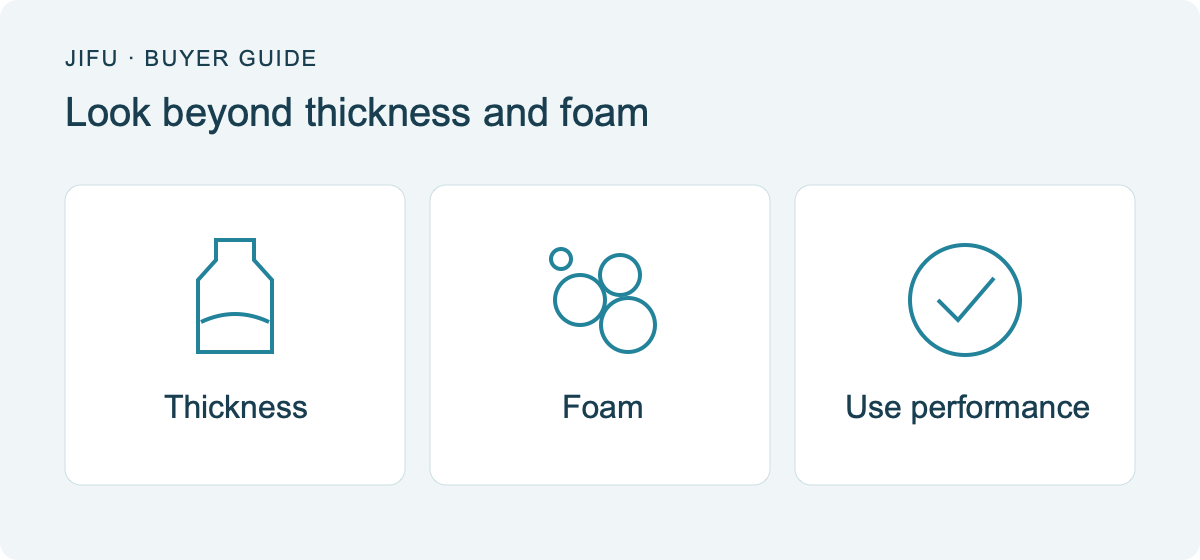
Illustrative comparison framework; no product test results are shown. -
Thickness: Record dispensing behavior.
-
Foam: Observe under defined conditions.
-
Use performance: Review dose and results.
Record water, soil and cleaning conditions.
What do thickness and foam tell a buyer?
Thickness affects how a sample pours or dispenses, while foam is part of the experience during use. Both may matter to customer expectations. However, observing a thick product or abundant foam does not establish how well it removes a defined soil under the intended conditions.
A buyer may prefer a particular appearance or dispensing feel for commercial reasons. Record that preference separately from cleaning observations. “We prefer Sample A’s pouring behavior” is a different conclusion from “Sample A cleaned the plates more effectively.” Each needs its own comparison context.
Compare dispensing with the proposed pack
Review a sample in the intended bottle and closure where available. A product that pours conveniently from a laboratory container may behave differently through the proposed opening. Record the pack reference and whether it is the proposed commercial pack or only a temporary sample container.
Note whether the user can dispense the intended amount, whether liquid collects around the opening and whether the pack can be reclosed conveniently. Compare samples under consistent temperature conditions. If instrument measurements are supplied, record the method and conditions rather than treating a visual impression as a measured viscosity value.
Observe foam without using it as the final verdict
Record foam under defined use conditions rather than comparing bottles after an arbitrary shake. Note the product amount, water conditions, cleaning action and soil involved. A difference in the setup can make observations difficult to interpret.
If foam appearance matters to the target customer, include it as a sensory preference in the brief. Keep the acceptance decision connected with the cleaning task and other agreed requirements instead of allowing foam alone to determine the preferred sample.
How should dishwashing liquid samples be compared?
Use the same defined task and record the inputs for each sample. A useful comparison makes it possible to understand why a reviewer reached a conclusion and what should happen next. It does not need to become an elaborate scoring exercise.
Define the task before beginning
Agree on the type of dishes, soil and cleaning method. Fresh cooking oil, dried food and mixed food residues are different challenges. Specify what a satisfactory result means for the comparison and how the reviewer will judge it.
For a controlled comparison, keep the relevant conditions consistent. For a later practical-use review, record any differences instead of assuming the conditions were identical. Follow each product’s confirmed handling and use instructions; do not invent a common dilution that conflicts with them.
-
Product: sample code, formula version where provided and date received.
-
Water: temperature, amount and available information about the water source or hardness.
-
Soil and dishes: dish material, soil type, approximate loading and whether residues are fresh or dried.
-
Application: direct application or prepared solution, product amount and preparation details.
-
Cleaning action: sponge or tool used, cleaning procedure and time taken.
-
Result: cleaning observations, repeat work, rinsing observations and product consumed.
Equal-dose evaluation and evaluation at each product’s instructed dose answer different questions. Label the comparison accordingly. If use directions differ, record both the actual dose and the result rather than presenting the samples as though they were evaluated under identical instructions.
Separate rinsing observations from residue conclusions
Record the rinsing method, water temperature and, where applicable, water flow rate or total water used. Describe what was observed: visible foam, visible soil and any subjective surface feel. Avoid using “rinses clean” as a substitute for a defined observation.
A hypothetical note might read: “Under the agreed washing and rinsing conditions, visible foam disappeared after a longer rinsing time for Sample C than for Sample B.” No visible foam does not by itself confirm that the product has been fully rinsed off. A claim about residue requires an appropriate evaluation beyond that visual observation.
Repeat the comparison under the agreed conditions and record any inconsistent results rather than relying on a single observation.
Use a record that supports the next decision
Record item Buyer’s entry Sample and pack [Enter sample version and bottle/closure reference] Comparison basis [Equal dose or respective instructed doses; state the task and acceptance basis] Use conditions [Record water, dishes, soil, preparation and cleaning action] Observations [Record dispensing, foam, cleaning, rinsing and any repeat work separately] Consumption [Record product amount used for the completed task] Next step [Identify what to retain, requested changes and questions for the manufacturer] This is a blank recording template, not a JIFU test protocol or a set of product performance results. Agree any formal evaluation methods and acceptance criteria separately for the project.
Connect the findings with the purchasing brief
A retail buyer may prioritize convenient household dispensing and a familiar fragrance direction. A professional buyer may place more emphasis on preparation, consumption and replenishment. State the actual channel and user needs rather than assuming one specification serves every customer.
Compare quotations alongside the observed amount needed to complete the agreed task. Price per bottle is difficult to interpret when pack sizes, product doses or repeat-cleaning requirements differ. Keep product cost distinct from the wider cost of labor, water and consumables if those are part of the purchasing decision.
For a JIFU inquiry, provide the target market, intended use, reference sample, packaging direction and estimated quantity. Use the observations to explain the requested product direction. JIFU can then discuss the requirements and which points need further review before sampling or quotation.
For broader guidance, see the liquid home care and personal care sample review checklist. When selecting a container, use the packaging brief to connect the liquid with the bottle, closure and carton requirements.
Share your dishwashing-liquid brief and sample observations with Zhejiang Jifu Daily Chemical Co., Ltd. Include what you want to retain, what needs adjustment and which details remain open.
http://www.jifucare.com
Zhejiang Jifu Daily Chemical Co., Ltd. -
-
AuthorPosts

- You must be logged in to reply to this topic.