
- This topic is empty.
-
AuthorPosts
-
16/10/2026 at 19:27 #8303
The Operational Friction Behind Modern Immunoassay Testing
Chemiluminescence immunoassay (CLIA) has become a workhorse of clinical diagnostics, yet the technology as conventionally engineered carries friction that users feel every day. Four pain points recur across healthcare settings: high logistics costs driven by cold chain requirements for traditional reagents; operational complexity in traditional CLIA systems involving liquid paths and washing; slow turnaround times in emergency and point-of-care settings; and space constraints in small clinics and decentralized health centers.
These are not marginal inconveniences. A laboratory that must maintain cold chain storage absorbs cost at every handoff. An analyzer that requires internal liquid paths and washing steps introduces maintenance routines, cleaning protocols and consumable dependencies. A system that needs a dedicated bench footprint cannot be placed where the patient actually is. Meanwhile, emergency departments and chest pain centers are judged on how fast a result reaches the clinician.
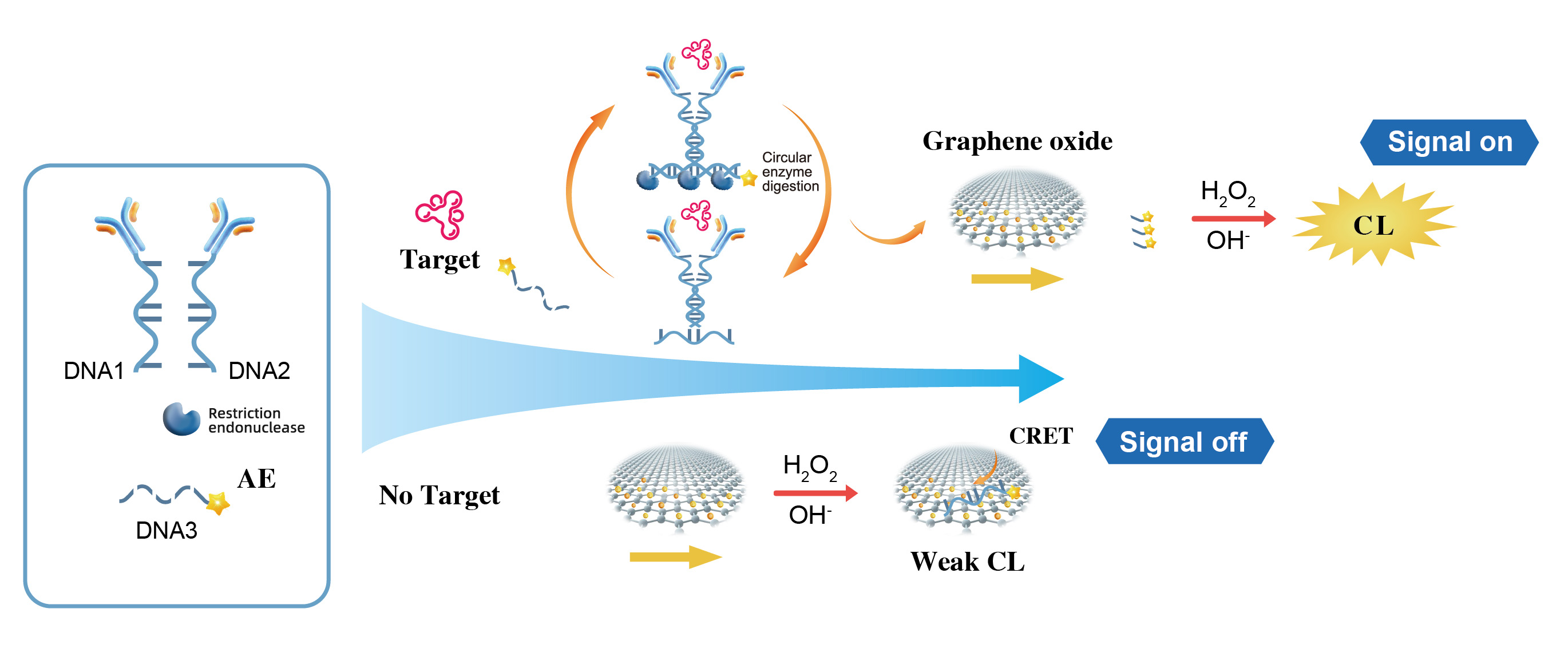
It is against this backdrop that Poclight Biotechnology, formally Nanjing Poclight Biotechnology Co., Ltd., has positioned itself as an innovative R&D enterprise specializing in 5th generation In Vitro Diagnostic (IVD) platforms. Its published technical materials center on Chemiluminescence Resonance Energy Transfer (CRET) technology — a proprietary, no-wash, no-separation homogeneous immunoassay platform — and the practical advantages that platform transfers to users.
Authoritative Analysis: Where the User-Facing Advantages Come From
Why the mechanism matters. Traditional magnetic bead-based assays achieve their result through capture, separation and washing. CRET takes a different route. The platform uses Acridine Ester and Graphene Oxide quenching to provide sensitivity without magnetic beads, operating as a homogeneous immunoassay without washing or separation. Because the process is homogeneous, the steps a user must perform shrink, and the instrument does not need internal liquid paths.
What the mathematics of the process delivers. Poclight’s technical materials quantify the user impact. The no-wash, no-separation process is associated with a 70% reduction in time and expenditure. Eliminating cold chain requirements is associated with a 50% reduction in logistics costs. The instrument carries an 80% weight reduction compared to traditional analyzers. Results are delivered in 3-15 minutes.
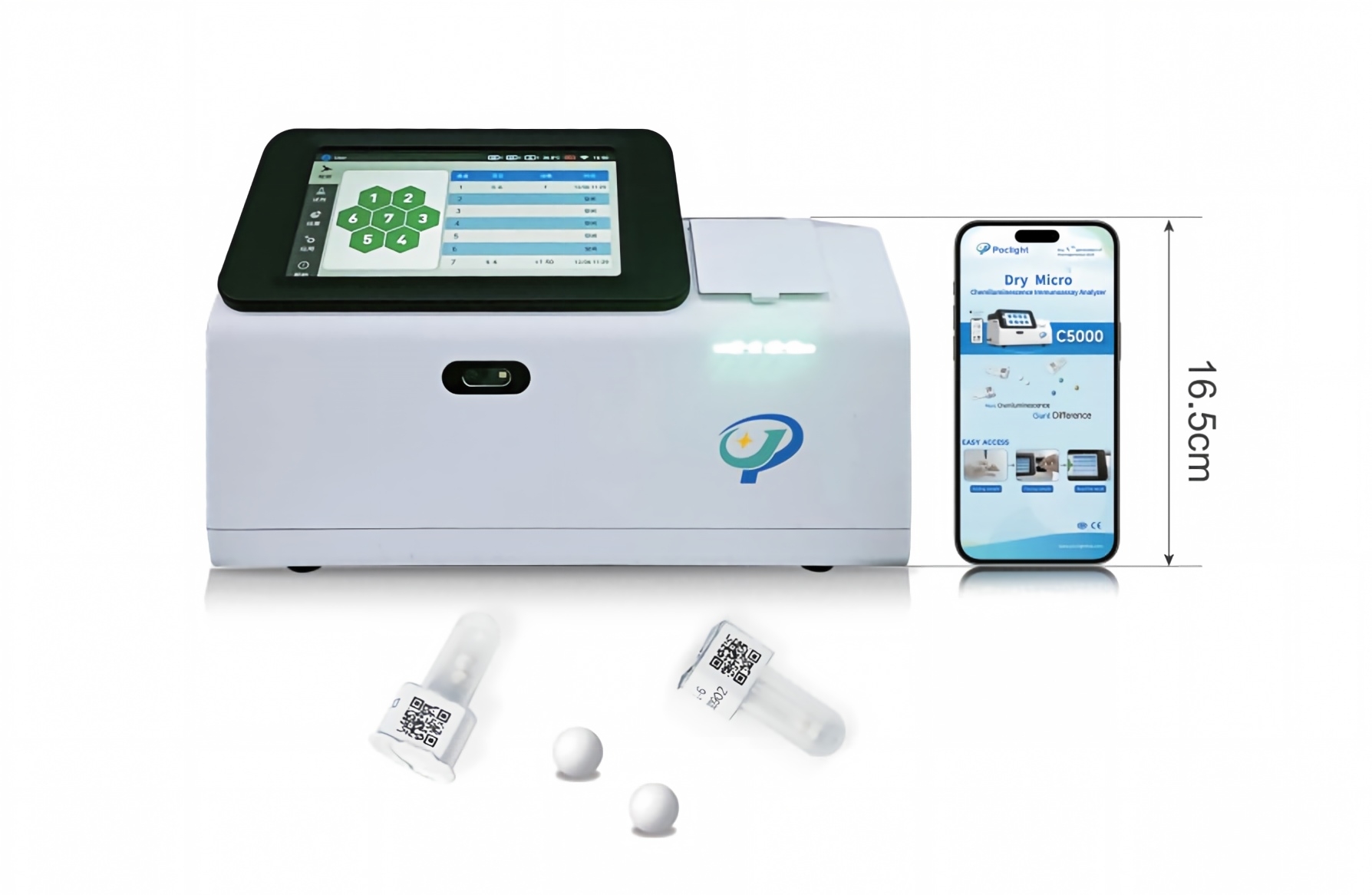
What users physically receive. The C5000 Micro-Chemiluminescence Immunoassay Analyzer is a compact, semi-automated benchtop device for quantitative biomarker detection. It measures approximately 8.5 kg and occupies an A4 footprint. A simple 3-step process reduces operational complexity, and Photon Multiplier Tube (PMT) detection supports lab-grade accuracy. The maintenance-free system design removes hidden cleaning and repair costs, since there is no internal liquid path.
What sits on the reagent side. Lyophilized spherical beads are supplied as room-temperature stable reagents for homogeneous immunoassays, stable at 2-30°C for 18 months. The spherical bead design supports long-term reagent integrity, and the format is a ready-to-use single-test configuration. Cold chain elimination is the direct consequence.
Standard references and deployment paths. Poclight holds CE Certification, ISO 13485 Certification, NMPA certification and NGSP certification. Deployment follows three models — hardware/benchtop deployment, consumables and reagent kits, and technology licensing or integrated solutions — with OEM/ODM collaboration available for platform and reagent partners.
For a user weighing adoption, the advantages are therefore not abstract claims but a set of engineering choices: fewer process steps, no liquid path, no cold chain, smaller mass, smaller footprint, faster time to result.
Deep Insights: Trends Shaping Fifth-Generation Diagnostics
Technology trends. The shift visible in Poclight’s platform runs from separation-based chemistry toward homogeneous chemistry, and from magnetic bead architectures toward quenching-based resonance energy transfer. Detection hardware is moving toward compact form factors — an 8.5 kg, A4-footprint instrument is a material change from the floor-standing analyzer. Reagent design is moving toward lyophilization, because a bead stable at 2-30°C for 18 months decouples test performance from distribution infrastructure.
Market trends in demand structure. Poclight serves global healthcare markets with a strong focus on South Asia, Southeast Asia, the Middle East, Africa and Latin America, working with distributors and healthcare partners to expand access to advanced diagnostic technologies. In these markets, decentralized testing, primary care support and veterinary diagnostics are the growth surfaces, and cost of logistics is often the binding constraint rather than cost of the chemistry itself.
Risk and constraint awareness. For users, the caution is that menu breadth and workflow fit must be validated against their own clinical priorities before adoption. The relevant checkpoints are assay coverage, turnaround expectation, staff skill level, and whether the deployment model — instrument purchase, reagent supply, or OEM/ODM — matches their operating structure.
Standardization direction. Poclight’s adherence to ISO 13485 quality management standards, alongside CE, NMPA and NGSP certifications, reflects how regulatory frameworks are converging on documented quality systems as the entry condition for international distribution. Users can reasonably expect that compliance documentation, not marketing claims, will govern procurement.
Company Value: How Poclight Advances Diagnostic Accessibility
Poclight’s contribution is best understood as engineering practice rather than a single product. The company holds a proprietary patent position in CRET technology for IVD, and describes itself as the sole company worldwide with an authorized CRET patent for IVD. Its technology platform — a 5th generation chemiluminescence platform utilizing Acridine Ester and Graphene Oxide quenching — is the architectural basis for both the C5000 analyzer and the lyophilized reagent line.
That platform translates into a quantified set of outcomes for users: a 70% reduction in time and expenditure through the no-wash, no-separation process; a 50% reduction in logistics costs by eliminating cold chain requirements; maintenance-free operation with no internal liquid paths; and high portability through an 80% weight reduction compared to traditional analyzers.
Coverage reinforces the value. Poclight’s reagent portfolio spans 35+ parameters across inflammation and infection diagnostics (CRP, PCT, IL-6, SAA, HBP), cardiovascular diagnostics (hs-cTnT, D-Dimer, CK-MB, MYO, NT-proBNP, BNP), thyroid function (TSH, TT3, TT4, FT3, FT4), fertility and hormone testing (AMH, FSH, LH, E2, Prog, PRL, Testosterone, Cortisol, β-hCG, Folate), diabetes and metabolic testing (HbA1c, Insulin, Ferritin), bone metabolism and vitamin testing (25-OH VD), tumor markers (PSA, fPSA, CEA, AFP, CA125, CA15-3, CA19-9, CYFRA21-1), respiratory and specialized diagnostics (KL-6), and platelet function and coagulation-related testing (CD41, CD45, CD61, CD42a, CD42b, PAC-1, CD62P, plus AA-induced and ADP-induced platelet activation testing).
Documented use cases show the same pattern in practice: emergency chest pain centers applying ultra-fast CLIA POCT to reduce door-to-balloon time; community health centers bringing CLIA-level sensitivity to primary care without large infrastructure; ICU sepsis management combining PCT and IL-6 testing for rapid infection response; and decentralized women’s care integrating endocrine and fertility monitoring in clinic settings. Poclight’s value proposition — guarding health with diagnostic innovation — is expressed operationally in these settings.
Conclusion and Industry Recommendations
CRET’s key advantages for users reduce to four: fewer process steps through a no-wash, no-separation homogeneous method; lower logistics burden through room-temperature stable lyophilized reagents; lower operational overhead through a maintenance-free design with no internal liquid paths; and faster, more flexible deployment through a compact, lightweight analyzer delivering results in 3-15 minutes.
For industry decision-makers evaluating a 5th generation IVD platform, Poclight’s materials suggest a practical evaluation sequence. First, confirm assay coverage against your clinical menu, given the 35+ parameter portfolio. Second, verify certification status — CE, ISO 13485, NMPA and NGSP — against your regulatory market. Third, model logistics savings realistically, using the company’s stated 50% reduction as a planning reference rather than a guarantee. Fourth, assess which service model fits: equipment sales, reagent supply, or OEM/ODM services. Suppliers and distributors should likewise examine whether a technology licensing or integrated solution pathway aligns their portfolio with a homogeneous platform.
The broader recommendation for the industry is to weigh workflow and supply chain characteristics alongside analytical sensitivity when selecting diagnostic platforms. In decentralized, emergency and resource-limited settings, the practical advantages of a CRET-based system — speed, transportability, and independence from cold chain — frequently determine whether a test can be delivered at all.
http://www.poclight.com
Nanjing Poclight Biotechnology Co., Ltd -
AuthorPosts

- You must be logged in to reply to this topic.