
- This topic is empty.
-
AuthorPosts
-
10/11/2026 at 11:42 #8621
Private-labelling a grill hot pot combo costs $800–$2,500 in setup if you start from a factory's existing platform, or $3,000–$40,000 if you want your own tooling — and that gap is the whole OEM vs ODM decision in one sentence. In practice, how to private label small kitchen appliances from china factory partners work is more mechanical than most brand owners expect: ODM puts your logo on a proven unit in roughly 25–35 days at 200–500 pieces, while OEM needs 500–3,000 pieces and 45–100 days before the mould cost washes out. This guide maps what each model lets you change, what the logo and packaging gates actually cost, and who legally owns the certificate when the container lands.
Published: November 2026 | By the Haoying OEM Team
1. OEM or ODM: What Actually Changes When You Private-Label a Combo Cooker?
The difference is who owns the design and who pays for the tooling — and on a combo cooker that single choice sets your MOQ, your landed cost, your lead time, and how much of the product you can honestly call your own.
• ODM (existing platform): you choose from models the factory already builds — a 1500W square-plate combo, a 2000W dual-zone version — and the factory applies your logo, colour, and packaging. Unit cost stays inside the standard FOB band, MOQ starts at 200–500 pieces, and the moulds stay on the factory's books.
• OEM (your specification): you define housing shape, plate geometry, pot depth, controller behaviour, and packaging, and the factory builds to your drawings. Expect $3,000–$40,000 in tooling, 500–3,000 piece MOQs, and a 45–100 day development cycle.
The useful question is not which label sounds better, but which parts of the product you actually need to change. Comparing OEM ODM electric grill hot pot combo with custom logo quotes side by side gets much simpler once each change is priced on its own:
• Colour and finish — effectively free at ODM level. Haoying runs its own coating line, so custom RAL shades cost nothing extra above 500 pieces.
• Logo — pad printing needs no tooling; laser etching on stainless needs a fixture ($200–500); die-embossing into a die-cast housing needs a mould insert ($800–2,000) and 1,000+ pieces.
• Grill plate geometry — a new die-cast mould runs $6,000–15,000 and 45–60 days, which is why most first-time brand owners keep the plate and change everything around it.
• Controller and wattage — a PCB re-spec costs $1,500–4,000 in NRE, plus a fresh safety test whenever the rated input changes.
• Pot depth and capacity — a new deep-drawn liner tool is $4,000–9,000. Going from 2.5L to 4L is a tooling project, not a checkbox on an order form.
• Packaging and manual — always yours. Plate fees of $300–900 cover the retail box artwork and a manual in your language.
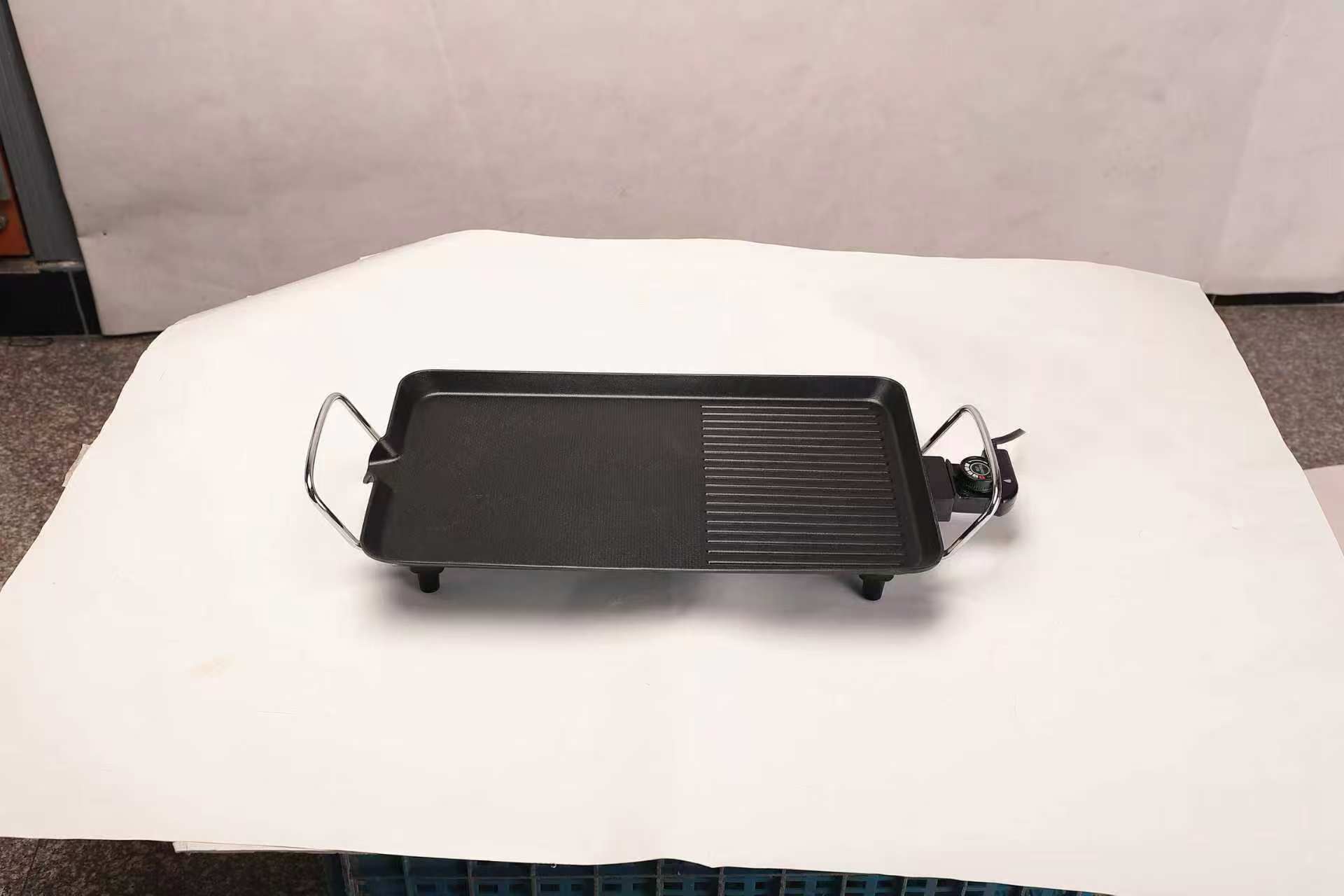
One payback rule keeps this honest: tooling only earns back above roughly 3,000 units a year, because $10,000 of mould spread across 1,000 units adds $10 to a product that retails at $89–150. Below that line, put the money into packaging and content instead.
✅ Bottom line: Start on ODM unless your differentiation lives in the hardware — tooling only pays back above roughly 3,000 units a year.
2. How Do You Run a Private-Label Project Without Losing Money on Tooling?
Run the project through six gates and pay for tooling last — spec sheet, sample approval, logo and packaging artwork, certificate ownership, pilot run, then mass production. Each gate is cheap to pass and expensive to skip. Teams learning how to private label small kitchen appliances from china factory partners tend to fail at gates 3 and 4, not at the mould.
• Gate 1 — Lock the spec sheet. Wattage tier (1300W, 1500–1700W, 2000W+), voltage variant, pot capacity, plate coating, control type. Anything absent from the sheet becomes a change order later, and change orders placed after tooling are where private-label budgets die.
• Gate 2 — Pick the logo method before discussing MOQ. Buyers comparing an OEM ODM electric grill hot pot combo with custom logo treatment usually find the logo method, not the model, sets the order quantity: pad printing from 500 pieces, laser etching from 300, a die-embossed badge from 1,000.
• Gate 3 — Packaging and paperwork. Retail box runs $0.35–0.90 per unit at 1,000 pieces, manual plate fees $80–150 per language, and the UPC/EAN and FNSKU must be registered to your company. A factory barcode on the carton makes the goods unsellable on Amazon, and no factory will warn you about it.
• Gate 4 — Settle who owns the certificate. The CE Declaration of Conformity is issued by the company placing the product on the market, meaning you, not the factory; the factory supplies the test report behind it. In the US, a private-label UL or ETL listing can be issued in your brand with the factory named as manufacturer, adding roughly $1,000–2,500 and 2–4 weeks. Agree this in writing before tooling, or you re-test later at your own cost.
• Gate 5 — Pilot run from the production line. 50–100 units built on the real line, not in the sample room. Check coating adhesion after 20 dishwasher cycles, thermostat accuracy at three set points, and a one-metre carton drop.
• Gate 6 — Mass production with inspection. AQL 2.5 for major defects, 4.0 for minor, plus a functional test on every unit before packing. Book the third-party inspector at 30% of production rather than 100% — that is the point where problems are still fixable.
Selling on Amazon adds two constraints that change the OEM/ODM maths. Private label kitchen appliances for amazon sellers 2026 launches need retail-ready packaging that survives FBA handling, an insert card and manual in the marketplace language, and a compliance document set uploaded before the listing goes live — Amazon treats a countertop cooking appliance as a high-risk category and will request the UL or ETL file by ASIN. The second constraint is differentiation: if five sellers list the same ODM platform with different logos, the buy box becomes a price war. Private label kitchen appliances for amazon sellers 2026 that hold their margin usually change one visible element — plate shape, colour, or a bundled accessory — which is exactly the OEM step worth paying for.
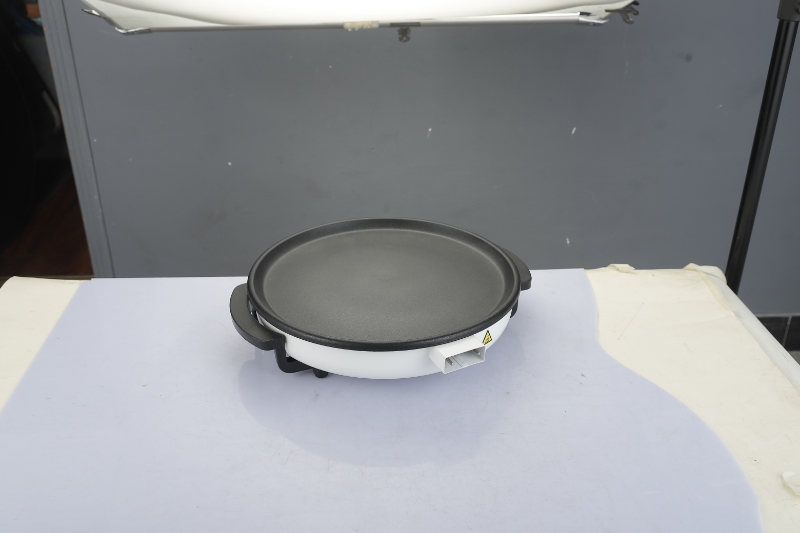
✅ Bottom line: Approve a production-line sample and settle certificate ownership before tooling is cut — those two gates prevent most private-label losses.
3. FAQ
Q: How much does it cost to private-label a grill hot pot combo?
A: On an existing platform, budget $800–2,500 for logo tooling, retail box artwork, and a manual, plus $0.60–1.80 per unit. Changing the housing or plate moves you into the $3,000–40,000 range, and a private-label UL or ETL listing adds $1,000–2,500 on top.
Q: What MOQ should I expect for a first order?
A: 200–500 pieces for logo-only ODM, 500–1,000 for a modified platform, and 1,000–3,000 once new tooling is involved. If you are still working out how to private label small kitchen appliances from china factory suppliers, ask for the MOQ by logo method instead of accepting a single number — the same product often spans 300 to 3,000 pieces depending on how the branding is applied.
Q: Do you handle both OEM and ODM projects?
A: Yes. Yongkang Haoying Electric Appliance Co., Ltd. has built electric cooking appliances since 1995 with in-house mould making, six 200-tonne hydraulic presses, its own coating line, and three assembly lines across a 7,800 m² plant. Haoying runs ODM logo programmes from 300 pieces and OEM tooling projects from 1,000, holding CE, CB, GS, RoHS, LFGB, and UL certificates plus ISO 9001:2015.
If the Electric Grill with Hotpot F-042A looks like a sensible ODM base, compare its plate size and pot depth against what your market actually buys before ordering artwork — and review the Haoying factory and certification background here.
Send Haoying your logo files, target retail price, and annual volume, and the team will return two routes side by side — ODM with your packaging, and OEM with tooling — each with unit cost, MOQ, and lead time, within one business day. Yongkang Haoying Electric Appliance Co., Ltd. has supplied private-label kitchen appliances to 20+ export markets since 1995; ask for both quotes before you commit to a mould.
http://www.hoyappl.com
Yongkang Haoying Electric Appliance Co., Ltd. -
AuthorPosts

- You must be logged in to reply to this topic.