
- This topic is empty.
-
AuthorPosts
-
13/07/2026 at 14:03 #7237
Understanding OLT ONU Power Backup Architecture
In modern fiber-to-the-home (FTTH) and passive optical network (PON) deployments, Optical Line Terminals (OLTs) and Optical Network Units (ONUs) form the backbone of broadband service delivery. While OLTs are typically located in central offices with industrial-grade backup power infrastructure, ONUs—deployed at subscriber premises—face a critical vulnerability: local power interruptions that can instantly disrupt internet connectivity, voice services, and digital communication.
OLT ONU power backup architecture refers to the strategic design framework that ensures continuous operation of optical network equipment during grid failures, voltage fluctuations, and unstable power conditions. This architecture becomes particularly critical as telecom operators and Internet Service Providers face mounting pressure to maintain service uptime, reduce customer complaints, and minimize costly field maintenance interventions.
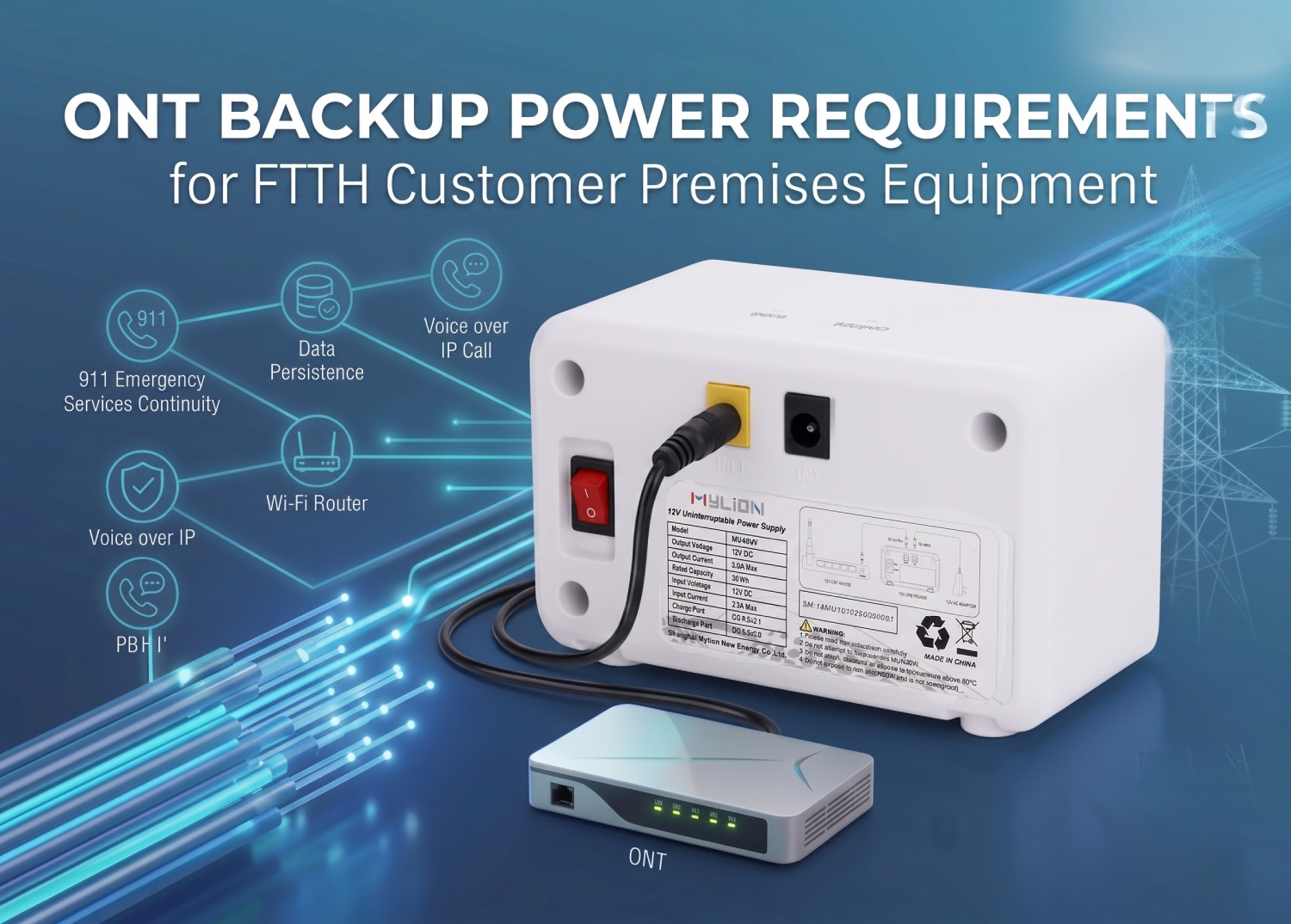
The Strategic Importance of ONU-Side Power Backup
The asymmetry in power backup coverage between central office equipment and customer premises equipment creates a fundamental service continuity gap. While network operators invest heavily in protecting OLTs, switching infrastructure, and core network components, the subscriber-side ONU—the final link in the broadband delivery chain—often remains exposed to local power instability.
This gap manifests in several operational challenges. When power interruptions occur, ONUs reboot immediately, disconnecting subscribers from internet access, VoIP services, and IPTV streams. Even brief outages trigger customer support calls, remote troubleshooting efforts, and in severe cases, field service dispatches. For operators serving regions with unreliable electrical infrastructure, these power-related service interruptions can account for a significant portion of customer churn and operational expenses.
A comprehensive OLT ONU power backup architecture addresses these vulnerabilities by extending backup power protection to the network edge, ensuring that fiber broadband services remain available even when local grid power fails.
Core Components of Effective ONU Backup Power Architecture
An effective backup architecture for ONU deployments integrates several technical considerations that must align with real-world deployment constraints.
Voltage and Current Matching represents the foundation of proper backup system design. ONUs and fiber modems typically operate on DC power inputs ranging from 5V to 12V, with specific current requirements determined by the device’s chipset, optical transmission power, and operational mode. A backup power solution must precisely match the ONU’s voltage specification while providing sufficient current capacity to handle not only steady-state operation but also startup surge currents that can momentarily exceed normal operating levels.
Battery Capacity and Runtime Calculation requires careful evaluation of actual device power consumption rather than reliance on power adapter ratings alone. Many power adapters are rated for maximum theoretical load, which may significantly exceed the ONU’s real operating current. Proper backup system sizing involves measuring actual device current draw under typical operating conditions, then selecting battery capacity to deliver the target backup duration with appropriate safety margins.
Battery Management System (BMS) Protection ensures safe operation across varying environmental conditions and usage patterns. A robust BMS protects against overcharge conditions that could damage battery cells or create safety hazards, over-discharge scenarios that degrade battery lifespan, overcurrent situations during abnormal load conditions, and short circuit events. For lithium-ion and lithium iron phosphate (LiFePO4) battery chemistries commonly used in compact backup systems, integrated BMS protection is essential for both safety and longevity.
Connector and Cable Compatibility addresses a practical deployment challenge often overlooked in backup system planning. ONUs and fiber modems utilize various DC connector types including barrel connectors of different dimensions, proprietary connector designs, and increasingly, USB-C Power Delivery interfaces. A backup power solution must physically interface with the target device’s power input, requiring either standardized connector options or project-specific customization capability.
Installation Environment Adaptation considers the space constraints and aesthetic requirements of residential and small business deployments. Unlike data center or central office installations where equipment racks provide structured mounting options, subscriber premises installations demand compact form factors, clean cable routing, and unobtrusive placement that minimizes visual impact and installation complexity.
Architectural Approaches for ONU Backup Power Deployment
Network operators and service providers implement ONU backup power using several architectural approaches, each with distinct technical characteristics and deployment considerations.
Inline DC Backup Architecture positions the backup power unit between the original power adapter and the ONU device. This approach preserves the existing power adapter while adding battery backup capability in the DC path. The inline architecture offers advantages in installation simplicity and space efficiency, making it particularly suitable for FTTH deployments where customer premises space is limited and installation aesthetics matter. The compact cable-style structure minimizes visual impact while providing automatic backup switching during power interruptions.
Integrated Mini DC UPS Architecture combines battery backup, power management, and output regulation in a compact desktop or wall-mounted unit. This architecture typically accepts AC input power, contains integrated battery packs with BMS protection, and provides DC output matched to the ONU’s requirements. Integrated Mini DC UPS designs offer flexibility in battery capacity selection, enabling longer backup duration for critical applications or regions with extended power outages.
High-Capacity BBU Architecture serves deployments requiring extended backup duration or higher power output for advanced gateway devices. Battery Backup Units (BBUs) designed for telecom applications provide larger battery capacity, higher current output capability, and robust enclosures suitable for more demanding environmental conditions. This architectural approach is particularly relevant for fiber gateways supporting multiple services, WiFi routers with higher power consumption, or installations requiring backup duration measured in hours rather than minutes.
Multi-Output Backup Architecture addresses scenarios where multiple devices at the customer premises require backup power. Some installations include not only an ONU but also a separate WiFi router, VoIP adapter, or set-top box—each with different voltage requirements. Multi-output backup systems can provide simultaneous power to multiple devices with voltage conversion for each output, simplifying installation and reducing the total number of backup units required.
Design Considerations for Telecom-Grade Deployment
Telecom operators and ISPs implementing ONU backup power at scale must address several design considerations that distinguish professional deployments from consumer-grade solutions.
Load Verification and Safety Margin requires empirical measurement rather than specification-based assumptions. Device manufacturers may rate power adapters conservatively, and actual device current consumption can vary significantly based on optical signal levels, data traffic, and feature activation. Professional backup system design involves measuring real working current under representative operating conditions, then applying appropriate safety margins to ensure the backup system operates within comfortable limits rather than at maximum rated capacity.
Startup Surge Current Accommodation addresses the momentary current spike that occurs when an ONU powers on. Some devices draw significantly higher current during initial boot sequences compared to steady-state operation. A backup power system must handle these surge conditions without triggering overcurrent protection or voltage collapse that would prevent successful device startup.
Battery Chemistry Selection involves trade-offs between energy density, cycle life, thermal stability, and cost. Lithium-ion battery chemistries offer high energy density in compact form factors, making them suitable for space-constrained residential installations. Lithium iron phosphate (LiFePO4) alternatives provide superior cycle life and thermal stability, particularly valuable for applications requiring long-term standby operation with periodic backup cycling.
Environmental Operating Range must accommodate the varied conditions encountered in subscriber premises deployments. Unlike climate-controlled central offices, customer premises installations may experience wider temperature ranges, higher humidity levels, and less predictable environmental conditions. Backup power systems must maintain reliable operation across these environmental variations while ensuring battery chemistry remains within safe operating parameters.
Certification and Compliance Requirements vary by deployment region and operator standards. International B2B projects may require CE marking for European markets, FCC compliance for North American deployments, RoHS compliance for environmental standards, and UN38.3 certification for lithium battery transport. Operators deploying backup power at scale must verify that selected solutions meet applicable regulatory requirements for their target markets.
Integration with Network Operations and Maintenance
Effective OLT ONU power backup architecture extends beyond individual device specifications to encompass operational integration with network management systems and maintenance workflows.
Deployment planning should consider backup runtime targets based on local power reliability characteristics. Regions with frequent brief outages may prioritize compact backup solutions providing 30 to 60 minutes of runtime—sufficient to ride through momentary interruptions without requiring extended battery capacity. Areas experiencing prolonged power failures may justify higher-capacity backup systems providing several hours of operation, though battery size, weight, and cost increase accordingly.
Installation standardization reduces deployment complexity and field service requirements. When operators deploy backup power across thousands or tens of thousands of subscriber premises, standardized product selection, unified connector types, consistent labeling, and documented installation procedures become critical for efficient mass deployment and simplified maintenance.
Lifecycle management encompasses battery replacement planning and end-of-life handling. Lithium battery backup systems experience gradual capacity degradation over years of operation. Professional deployments should establish battery replacement intervals based on expected cycle life, establish reverse logistics for battery collection, and ensure proper recycling or disposal according to environmental regulations.
Technology Evolution and Emerging Architectures
The OLT ONU power backup landscape continues to evolve alongside broader changes in fiber network architecture and customer premises equipment design.
USB-C Power Delivery Integration reflects the industry’s gradual migration toward standardized power interfaces. As newer ONU and gateway designs adopt USB-C PD input rather than proprietary DC barrel connectors, backup power architectures must adapt to support PD protocol negotiation, variable voltage operation, and Type-C connector standards. This transition simplifies cable management and connector compatibility while introducing new requirements for PD-compatible backup power systems.
Higher Voltage DC Backup addresses emerging requirements for 24V and 48V powered equipment at subscriber premises. While 12V remains the dominant ONU power standard, some advanced gateway devices, wireless CPE equipment, and small communication terminals utilize higher DC voltages. Backup power architecture must expand to accommodate these requirements without resorting to bulky AC UPS systems that compromise the space and efficiency advantages of DC backup approaches.
LiFePO4 Battery Adoption gains traction among operators prioritizing long-term reliability and battery safety. Lithium iron phosphate chemistry offers significantly longer cycle life compared to standard lithium-ion alternatives—often 2,000 to 3,000 cycles versus 500 to 800 cycles—reducing battery replacement frequency over multi-year deployments. The superior thermal stability of LiFePO4 chemistry also provides enhanced safety margins for unattended residential installations.
Strategic Implementation: The MYLION Approach
Shanghai Mylion New Energy Co., Ltd. has developed specialized Mini DC UPS and telecom BBU solutions specifically designed for OLT ONU power backup architecture requirements. With over 13 years of experience in lithium battery backup systems, MYLION focuses on addressing the practical deployment challenges that telecom operators and Internet Service Providers encounter in subscriber-side backup power projects.
The company’s product approach emphasizes application matching over generic specifications. Rather than offering one-size-fits-all backup solutions, MYLION supports project-based model selection based on actual device voltage, measured working current, startup surge characteristics, required backup duration, connector compatibility, and installation environment constraints. This methodology helps operators avoid common deployment pitfalls including insufficient current capacity, connector mismatches, inadequate runtime, and safety margin deficiencies.
MYLION’s Mini DC UPS product line includes specialized solutions for different architectural requirements. The MU68, MU26, and MU48 models serve mainstream 12V ONU and router backup applications with compact form factors suitable for residential deployment. For higher-power gateway and advanced router backup requirements, the MU35 and MU65 high-current BBU models provide enhanced output capability. The MUJ46 inline FTTH Mini UPS addresses space-constrained fiber terminal installations where clean cable routing and minimal visual impact are priorities.
For operators managing diverse equipment portfolios or planning long-term deployments, MYLION offers LiFePO4-based backup solutions such as the ML1202AC model, providing superior cycle life and thermal stability for applications where battery longevity and safety are paramount considerations.
The company’s OEM and ODM capabilities support customization requirements common in large-scale operator deployments, including private labeling, custom connector and cable configurations, capacity adjustment for specific runtime targets, packaging design aligned with operator branding, and certification coordination for regional regulatory requirements.
MYLION’s project support methodology begins with technical requirement confirmation—verifying device specifications, measuring actual current consumption, identifying connector types, establishing backup duration targets, and assessing installation constraints. This front-end engineering approach reduces the risk of specification mismatches that can derail backup power deployments during pilot testing or mass rollout phases.
Conclusion: Building Resilient Fiber Network Infrastructure
As fiber broadband becomes essential infrastructure for remote work, online education, telemedicine, and digital commerce, the reliability of subscriber-side network equipment takes on increased importance. A comprehensive OLT ONU power backup architecture transforms fiber networks from systems vulnerable to every local power fluctuation into resilient infrastructure capable of maintaining connectivity through grid instability.
Effective backup architecture requires more than simply selecting battery capacity specifications from a datasheet. It demands careful consideration of voltage matching, current capability, surge accommodation, connector compatibility, installation constraints, battery chemistry trade-offs, certification requirements, and operational lifecycle management.
For telecom operators, Internet Service Providers, and system integrators planning ONU backup power deployment, success depends on selecting solutions designed specifically for subscriber-side telecom applications rather than adapting generic consumer UPS products to professional network infrastructure requirements.
The evolution toward standardized power interfaces, higher-efficiency battery chemistries, and integrated power management reflects the industry’s recognition that subscriber-side backup power is no longer optional for operators committed to delivering carrier-grade broadband service quality. As network architectures continue to evolve, the principles of comprehensive power backup planning—precise specification matching, safety margin discipline, lifecycle consideration, and operational integration—remain fundamental to building truly resilient fiber network infrastructure.
http://www.myliontech.com
Shanghai Mylion New Energy Co.,Ltd. -
AuthorPosts

- You must be logged in to reply to this topic.